17-4PH Stainless Steel Bar: Properties, Heat Treatment Conditions and AMS 5643 Requirements
17-4PH stainless steel bar, also known as Type 630 or UNS S17400, is a martensitic precipitation-hardening stainless steel. It combines high strength and hardness with moderate corrosion resistance, and its final performance depends strongly on the selected aging condition. For buyers, specifying only “17-4PH bar” is therefore incomplete: the order should also identify the product standard, dimensions, delivery condition, required heat-treatment condition and inspection documents.
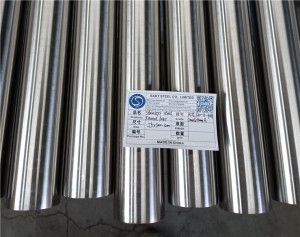
17-4PH is normally solution treated to Condition A and then aged between 900°F and 1150°F (482°C to 621°C). H900 generally provides the highest strength and hardness. As the aging temperature increases through H1025, H1075 and H1150, strength and hardness decrease while ductility and impact toughness generally improve. H1150M is a double-aging treatment used when greater toughness, lower hardness or improved machinability is required. The correct condition must be selected from the governing specification and service requirements—not from hardness alone.
View 17-4PH 630 Stainless Steel Bar
What Is 17-4PH Stainless Steel?
The name “17-4PH” refers to an alloy containing approximately 17% chromium and 4% nickel, strengthened by copper precipitation. After solution treatment and cooling, the microstructure is predominantly martensitic. A subsequent aging treatment forms fine copper-rich precipitates that increase strength and hardness.
| Designation System | Common Designation | Buyer’s Note |
|---|---|---|
| UNS | S17400 | Primary unified grade designation |
| AISI / Type | 630 | Frequently used in ASTM product specifications |
| EN | 1.4542 / X5CrNiCuNb16-4 | Often treated as the European counterpart; confirm the required EN product standard |
| JIS | SUS 630 | Confirm the applicable JIS standard and condition |
17-4PH Chemical Composition
The following ranges are a commonly published type analysis for 17-4PH / Custom 630. They are useful for grade identification, but acceptance of an actual heat must be based on the chemical limits in the specified material standard and the values reported on the mill test certificate.
| Element | Published Range, wt.% | Metallurgical Role |
|---|---|---|
| Chromium | 15.00–17.50 | Supports passivation and corrosion resistance |
| Nickel | 3.00–5.00 | Assists phase balance and toughness |
| Copper | 3.00–5.00 | Forms strengthening precipitates during aging |
| Niobium + tantalum | 0.15–0.45 | Contributes to precipitation-hardening response |
| Carbon | 0.070 max. | Controlled to limit unwanted carbide-related effects |
| Manganese / silicon | 1.00 max. each | Process and deoxidation-related residual controls |
| Phosphorus / sulfur | 0.040 / 0.030 max. | Restricted residual elements |
| Iron | Balance | Base metal |
How Does 17-4PH Heat Treatment Work?
The heat-treatment route has two distinct stages. First, solution treatment dissolves alloying constituents and prepares the martensitic matrix. This delivery state is commonly called Condition A. Second, the material is reheated at a lower temperature for a specified time so that strengthening precipitates form. This is the precipitation-hardening, or aging, stage.
Solution treated
martensitic structure
H900 / H1025 / H1075 / H1150
Strength ↔ toughness, hardness and ductility
Starting condition
Approximately 1400°F (760°C), air cool, then 1150°F (621°C), air cool
The “H” designation identifies the nominal aging temperature in degrees Fahrenheit. H900 therefore means aging at approximately 900°F, while H1150 means aging at approximately 1150°F. It does not identify the hardness value.
| Condition | Typical Published Aging Practice | General Property Direction | Typical Selection Reason |
|---|---|---|---|
| Condition A | Solution treated at approximately 1900–1950°F (1040–1065°C), then cooled as specified | Unaged martensitic condition | Common supply and machining condition before final aging |
| H900 | 900°F (482°C), about 1 hour, air cool | Highest strength and hardness; lower toughness than overaged conditions | High static strength and wear resistance where the design permits |
| H1025 | 1025°F (552°C), about 4 hours, air cool | High strength with improved toughness compared with H900 | Balanced strength, toughness and corrosion-related considerations |
| H1075 | 1075°F (579°C), about 4 hours, air cool | Lower strength and hardness; higher ductility and impact energy | Components needing a more forgiving strength–toughness balance |
| H1150 | 1150°F (621°C), about 4 hours, air cool | Overaged; reduced hardness with greater ductility and toughness | Toughness, lower hardness and improved resistance to some cracking mechanisms |
| H1150M | 1400°F (760°C) for about 2 hours, air cool; then 1150°F (621°C) for about 4 hours, air cool | Double aged; lowest strength of the conditions shown, with high toughness and good machinability | Machining stock, larger sections or service requiring a lower hardness level |
Typical Mechanical-Property Trend by Aging Condition
The following figures are representative room-temperature values published for one producer’s 17-4PH material. They illustrate the effect of aging temperature; they are not universal acceptance limits. Actual results vary with bar diameter, melting route, processing history, heat-treatment equipment, test direction and specification revision.
| Condition | 0.2% Yield Strength, MPa | Tensile Strength, MPa | Elongation, % | Typical Hardness, HRC |
|---|---|---|---|---|
| H900 | 1262 | 1365 | 15 | 44 |
| H1025 | 1117 | 1158 | 16 | 38 |
| H1075 | 1020 | 1131 | 17 | 36 |
| H1150 | 869 | 993 | 20 | 33 |
| H1150M | 600 | 848 | 22 | 29 |
This trend explains why H900 should not automatically be selected simply because it has the highest strength. A shaft, valve component, fastener or aerospace part may be limited by fatigue, impact loading, stress-corrosion cracking, dimensional stability or machinability rather than static tensile strength alone.
AMS 5643 vs ASTM A564: What Is the Difference?
AMS 5643 is an aerospace material specification for corrosion-resistant precipitation-hardenable steel supplied in forms including bars, wire, forgings, mechanical tubing and rings. ASTM A564/A564M covers hot-rolled and cold-finished age-hardening stainless steel bars and shapes, including rounds, squares, hexagons and structural shapes produced by routes such as rolling, extrusion or forging.
| Item | AMS 5643 | ASTM A564/A564M |
|---|---|---|
| Primary context | Aerospace material procurement | General industrial age-hardening stainless bar and shape procurement |
| Product-form scope | Includes bar and several additional wrought forms named by the specification | Bars and shapes; forgings as finished products are normally addressed separately |
| Ordering basis | Purchase order must identify the required AMS revision and condition | Purchase order should identify A564 or A564M units, grade, condition, size and supplementary requirements |
| Can one replace the other? | No automatic substitution. Customer, design authority and governing code approval may be required. | |
For a purchase order, “AMS 5643 material” is not just another name for “ASTM A564 Type 630.” Even when the chemistry and heat-treatment designation appear similar, the specification scope, sampling, acceptance criteria, testing and documentation route may differ. Always use the standard named on the drawing or approved material list.
How to Choose the Correct 17-4PH Condition
- Start with the drawing and governing specification. Confirm whether the requirement is AMS 5643, ASTM A564/A564M, ASME SA-564 or another approved standard.
- Identify the controlling failure mode. Maximum tensile strength may not be the design priority if the component sees impact, cyclic loading, hydrogen, chlorides or sour-service exposure.
- Review section size and test location. Large bars can show property variation between surface, mid-radius and center locations. Do not assume small-specimen data represents every position in a large section.
- Decide when final aging will occur. Material may be purchased in Condition A for machining and aged after machining, or supplied in a specified aged condition. This choice affects machining, distortion control and final verification.
- Specify testing and documents. State tensile, hardness, impact, ultrasonic, PMI, corrosion or third-party inspection requirements before quotation.
Applications and Important Limits
17-4PH bar is used for high-strength shafts, valve parts, pump components, fasteners, aerospace fittings, tooling, medical instruments and industrial machine components. The alloy is attractive when high strength is needed together with better general corrosion resistance than conventional hardenable 400-series stainless steels.
However, 17-4PH should not be described as universally seawater-resistant or as a direct upgrade from 316 stainless steel. Published producer data describe its corrosion resistance as approaching Types 302 and 304 in many environments, while seawater performance is application-dependent and can be restricted. Chloride concentration, temperature, crevices, residual stress, surface condition and aging condition all matter. For continuous marine or highly aggressive chemical service, a corrosion review and application-specific testing may be necessary.
Inspection and Mill Test Certificate Checklist
- Grade identification: UNS S17400 / Type 630
- Applicable standard and revision: for example, AMS 5643 or ASTM A564/A564M
- Heat number and traceability to bar marking and packaging
- Actual chemical analysis for the supplied heat
- Delivery condition and completed aging condition
- Tensile strength, yield strength, elongation and hardness results where required
- Specimen orientation and test location for large or critical sections
- Impact testing, ultrasonic testing, PMI or other supplementary examinations when specified
- Certificate type and third-party witnessing requirements
For a step-by-step document review, see How to Read a Stainless Steel Mill Test Certificate (MTC). Buyers who need information about the upstream production route can also read How Is Stainless Steel Bar Made?
17-4PH Stainless Steel Bar RFQ Checklist
Include the following information in your inquiry:
- Grade: 17-4PH / UNS S17400 / Type 630
- Standard and revision: AMS 5643, ASTM A564/A564M or project specification
- Shape and size: round, square, hexagon or flat bar; diameter/thickness and length
- Delivery condition: Condition A, H900, H1025, H1075, H1150, H1150M or another approved condition
- Surface and tolerance: black, peeled, turned, ground, polished or precision cold-finished
- Quantity and unit basis
- Required tests, inspection documents, marking and packing
- End-use environment and any design-authority approval restrictions
Frequently Asked Questions
What is 17-4PH stainless steel equivalent to?
Common corresponding designations include UNS S17400, AISI Type 630, EN 1.4542 / X5CrNiCuNb16-4 and JIS SUS 630. They should be treated as comparable grade designations, not as automatically interchangeable product specifications.
Is 17-4PH stainless steel magnetic?
Yes. Because 17-4PH develops a predominantly martensitic structure, it is normally magnetic in both solution-treated and aged conditions. Magnet response alone cannot verify grade or heat-treatment condition.
What does H900 mean?
H900 identifies an aging treatment performed at a nominal temperature of 900°F (482°C). It does not mean 900 HB, 900 HV or any other hardness value. H900 generally produces the highest strength and hardness among the commonly specified 17-4PH aging conditions.
What is the difference between H1150 and H1150M?
H1150 is a single aging treatment at about 1150°F (621°C). H1150M is a modified double-aging cycle, typically using an initial treatment near 1400°F (760°C) followed by aging near 1150°F. H1150M generally produces lower hardness, improved toughness and favorable machinability, but the governing specification must define the required cycle and properties.
Can 17-4PH be supplied annealed?
Condition A is frequently called the solution-treated or solution-annealed condition. The term “annealed” can be misleading if used without the condition designation, because the material remains martensitic and is normally aged before final service. State “Condition A” on the order when that is what is required.
Is 17-4PH better than 316 stainless steel?
Neither grade is universally better. 17-4PH is selected for much higher achievable strength and hardness. 316 is an austenitic stainless steel often preferred for corrosion resistance, formability and weldability in many chloride-related applications. Selection must be based on the actual mechanical, corrosion, fabrication and code requirements.
Can 17-4PH stainless steel be welded?
17-4PH can be welded using appropriate stainless-steel welding practices. Final properties depend on the base-metal condition, filler selection, heat input and postweld heat treatment. Critical components require a qualified welding procedure and engineering review.
Conclusion
The most important purchasing decision for 17-4PH stainless steel bar is not simply the alloy name—it is the complete combination of grade, product standard, size, surface condition, heat-treatment condition and inspection requirement. H900 maximizes strength and hardness, while higher-temperature aging conditions progressively favor ductility, toughness and lower hardness. AMS 5643 and ASTM A564/A564M should be specified according to the required product form and project approval route.
For quotations, send the required standard, dimensions, heat-treatment condition, quantity and inspection documents with your inquiry. Contact Saky Steel to discuss 17-4PH stainless steel bar availability and documentation requirements.
Post time: Jun-09-2026