Quick answer. Machined 303 stainless steel can be passivated using a procedure selected for its sulfur-bearing, free-machining composition. Before ordering, agree on the finished-part condition, treatment specification, acceptance test and reporting. The grade, part geometry and machining residues all influence the process.
Why 303 needs a grade-specific review
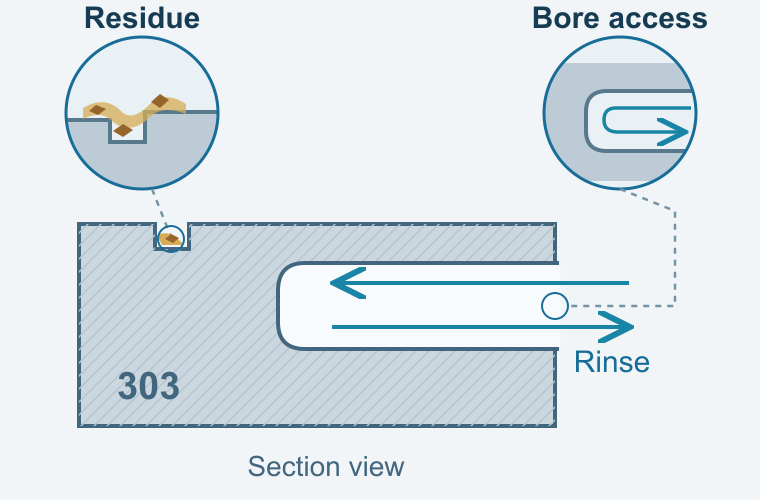
Sulfur additions help 303 break chips during machining. They also make its surface response during chemical treatment important. Sulfide inclusions exposed at a machined surface can be affected by the bath, and small surface cavities can retain solution. Cleaning, rinsing and any required neutralization therefore need to suit the actual material and component.
Give the processor the grade identity and drawing before choosing a treatment. Blind holes, threads, cross-drilled passages and close-fitting assemblies deserve particular attention because retained machining fluid and treatment solution can be difficult to remove.
For the starting material, review the 303 stainless steel round bar page. Specify the bar condition and dimensions separately from the surface treatment required after machining.
Set the requirements before processing
- Confirm the material and surface. Identify 303 and the relevant material specification, heat or lot. Tell the processor about cutting fluids, polishing compounds, embedded iron, burrs, scale and any previous treatment.
- Define the treatment requirement. State the applicable specification and edition, together with any customer-approved procedure. ASTM A380/A380M addresses cleaning, descaling, pickling and passivation practices. ASTM A967/A967M covers chemical passivation treatments and alternative verification tests.
- Review access and final condition. Agree on drainage and rinsing of internal features, protected areas, surface appearance, critical dimensions and subsequent handling. Trials on representative parts can be useful when geometry or a new machining route creates uncertainty.
- Choose acceptance and documentation. The order should identify the applicable verification method, sampling or lot basis, acceptance criteria and report. Check method suitability against the grade and governing specification.
Process note. Nitric- and citric-based treatments are among the routes covered by ASTM A967/A967M. The qualified processor should select and control the applicable route. The required cycle depends on the specification, material and part condition.
Match each document to the question it answers
| Document or check | What the buyer should verify |
|---|---|
| Bar material certificate | Grade, traceability and the material test results ordered for the starting bar. |
| Treatment record | Finished-part identity, process specification and edition, treatment lot and processor. |
| Verification result | The agreed method, sample identification, acceptance criteria and recorded outcome. |
| Final inspection | Appearance, critical dimensions and cleanliness after processing, rinsing, drying and handling. |
The qualitative verification methods in ASTM A967/A967M assess treatment effectiveness, particularly contaminant removal. Suitability for the intended fluid, temperature and exposure remains a separate material-selection question.
Questions to resolve before release
Can passivation replace cleaning?
Oil, machining debris and other residues need appropriate removal before the selected passivation step. Scale or heat tint may require a separate preparation process. Agree on the incoming condition so the processor can assess it.
How should staining or pitting after treatment be handled?
Hold the affected lot for investigation. Check material identity, preparation, treatment control, rinsing and handling against the approved procedure. Inspect for surface attack before authorizing rework.
What should a bar enquiry include?
Send the grade and material standard, diameter, tolerance, supplied condition, length, quantity and certificate requirement. Add the intended machining and finished-part surface requirements so these can be reviewed when discussing the material order.
Post time: Nov-11-2026