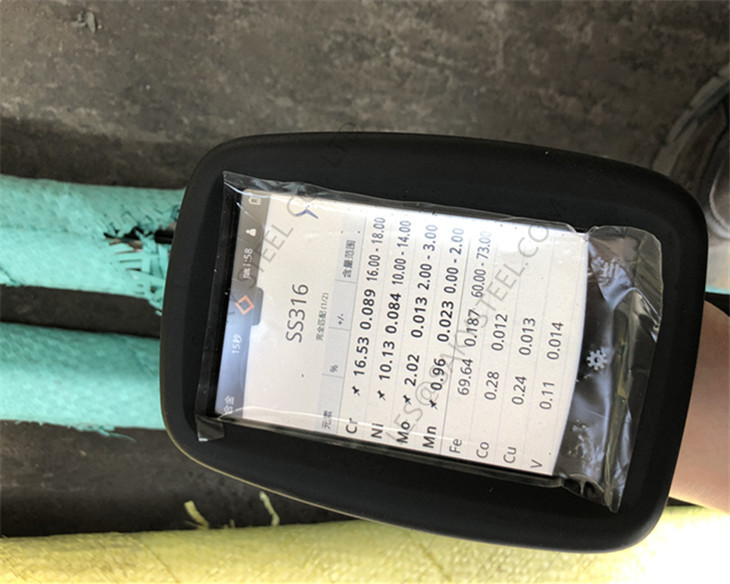
Can Handheld XRF PMI Correctly Identify Stainless Steel Grades?
Handheld XRF is widely used for positive material identification because it can quickly measure many alloying elements directly on stainless steel products. It is especially useful for reducing material-mix risk in bars, plates, pipes, fittings and fabricated components.
However, XRF does not identify every stainless steel grade with the same level of certainty. It works well when grades differ clearly in elements such as molybdenum, titanium, niobium, nickel or copper, but it has important limitations when the main difference is carbon content.
Quick Answer
Handheld XRF PMI can usually distinguish many stainless steel grades by measuring alloying elements such as chromium, nickel, molybdenum, titanium and niobium.
It can normally distinguish 304 from 316 because 316 contains significant molybdenum. However, conventional handheld XRF cannot reliably distinguish low-carbon grades such as 304 from 304L or 316 from 316L because carbon is not accurately measured by standard handheld XRF instruments.
PMI should therefore be used together with the MTC and, where necessary, laboratory chemistry or another suitable analytical method.
How Handheld XRF PMI Works
X-ray fluorescence analysis identifies elements by measuring characteristic X-rays emitted from the material after excitation. A handheld analyzer can therefore estimate the concentrations of many metallic alloying elements directly on the product surface.
For stainless steel PMI, this makes XRF useful for checking elements such as chromium, nickel, molybdenum, copper, titanium and niobium. These elements can help separate many common stainless steel grades.
The reading is influenced by instrument calibration, surface condition, measurement time and the material being tested. PMI should therefore follow an agreed inspection procedure rather than being treated as a simple visual grade check.
Which Stainless Steel Grades Can XRF Usually Distinguish?
| Grade Pair | Can Handheld XRF Usually Distinguish Them? | Main Reason |
|---|---|---|
| 304 vs 316 | Usually yes | 316 contains significant molybdenum |
| 304 vs 304L | Not reliably | The key difference is the carbon limit |
| 316 vs 316L | Not reliably | The key difference is the carbon limit |
| 304 vs 321 | Usually yes | 321 contains titanium |
| 304 vs 347 | Usually yes | 347 contains niobium |
| 316L vs 904L | Usually yes | 904L has significantly different Ni, Mo and Cu levels |
| 304/316 vs Duplex 2205 | Usually yes | Duplex grades have a distinct alloying-element combination |
This table is a practical PMI guide, not a substitute for the applicable material standard. Final acceptance should still be based on the required grade specification and project documentation.
Can XRF Distinguish 304 from 316?
In most normal PMI situations, yes. 304 and 316 have different molybdenum contents, and handheld XRF can usually detect this difference clearly.
304 normally contains little or no intentional molybdenum, while 316 contains a significant molybdenum addition. This is one of the main reasons 316 generally provides better resistance to localized corrosion in many chloride-containing environments.
For incoming material inspection, a clear molybdenum reading can therefore help separate 304 from 316 quickly. However, the measured result should still be compared with the applicable grade chemistry rather than relying only on the analyzer’s automatic grade name.
Why XRF Cannot Reliably Distinguish 304 from 304L
The difference between 304 and 304L is primarily the maximum permitted carbon content. The same issue applies to 316 and 316L.
Conventional handheld XRF instruments are not suitable for accurately measuring the low carbon levels needed to confirm an “L” grade. As a result, a handheld XRF reading may identify the alloy family as 304 or 316 but cannot by itself prove that the material meets the low-carbon requirement for 304L or 316L.
Important: A handheld XRF result showing “316” should not automatically be used to certify 316L. Low-carbon grade confirmation requires appropriate chemistry documentation or a suitable analytical method.
What Should Be Used to Confirm 304L or 316L?
If the low-carbon designation is important to the project, buyers should use a verification method capable of confirming the required carbon level.
Depending on the inspection plan, this may include:
• review of the heat-specific MTC;
• laboratory chemical analysis;
• optical emission spectroscopy where suitable;
• combustion analysis when accurate carbon determination is required;
• project-approved product analysis where specified.
The correct method should be selected according to the product standard and project acceptance requirement.
How XRF Identifies 321 and 347 Stainless Steel
Stabilized austenitic grades are another useful example of where handheld XRF can provide practical grade-verification information.
321 contains titanium as a stabilizing element. 347 uses niobium for stabilization. Because these elements can be detected by suitable XRF instruments, PMI can often help distinguish these grades from conventional 304-type material.
However, a PMI reading does not verify the full heat-treatment condition, grain structure or mechanical properties. It confirms only the elemental information within the capability of the selected method.
Can XRF Identify 904L and Duplex Stainless Steel?
Grades with substantially different alloying-element combinations are generally easier to separate by handheld XRF.
904L has higher nickel and molybdenum levels than standard 300-series stainless steels and also contains copper. Duplex grades such as 2205 and super duplex grades have their own characteristic chromium, nickel, molybdenum and other alloying patterns.
These differences make XRF useful for detecting many material mix-ups during receiving inspection, warehouse control and fabrication.
How Accurate Is Handheld XRF?
Handheld XRF can provide reliable alloy-verification information when the instrument is suitable for the material, correctly calibrated and used by trained personnel. Accuracy is not determined by the instrument alone.
Factors that can affect the result include:
• surface contamination;
• paint, scale or plating;
• curved or irregular test surfaces;
• short measurement time;
• calibration and instrument condition;
• sample thickness;
• low concentrations close to the method’s detection capability.
For critical inspection, the test surface should be prepared as required and the result should be reported against an agreed grade or elemental acceptance basis.
PMI Does Not Replace the MTC
PMI and an MTC serve different purposes. PMI is commonly used to reduce material-mix risk by checking alloying elements on the actual product. The MTC provides heat-specific certified information from the material producer.
| Check / Document | Main Purpose | What It Does Not Automatically Prove |
|---|---|---|
| Handheld XRF PMI | Checks detectable alloying elements on the actual product | Low-carbon grade, mechanical properties or heat-treatment condition |
| MTC | Heat-specific chemistry, mechanical properties and traceability as applicable | That the physical item has not been mixed with another grade after production |
| Hardness Test | Verifies hardness at the tested position | Alloy identity |
| UT / PT | Evaluates specified internal or surface discontinuities | Chemical composition |
For high-value stainless steel orders, PMI and MTC review can therefore be complementary rather than interchangeable.
XRF vs OES for Stainless Steel Verification
XRF and optical emission spectroscopy are both used for material analysis, but they have different capabilities and field applications.
| Item | Handheld XRF | OES |
|---|---|---|
| Portability | Very suitable for field PMI | Equipment and setup depend on the system |
| Surface Damage | Generally nondestructive at the test location | Produces a small burn / spark test area |
| Major Alloy Elements | Well suited to many stainless steel PMI tasks | Suitable for detailed chemistry analysis |
| Carbon Verification | Not reliable for confirming low-carbon stainless grades | Can be suitable when the equipment and method are configured for carbon analysis |
| Typical Use | Rapid receiving, warehouse and fabrication PMI | More detailed grade confirmation where broader chemistry is required |
Where PMI Adds Value in Stainless Steel Procurement
PMI becomes especially useful when multiple similar-looking stainless steel grades are stored or processed in the same facility. Bars, plates, pipes and fittings can appear nearly identical after pickling, polishing or machining.
Typical PMI uses include:
• incoming material verification;
• warehouse alloy segregation;
• checking cut pieces after original markings are removed;
• verifying components before fabrication;
• reducing 304 / 316 mix-up risk;
• supporting project traceability requirements;
• final PMI before shipment when specified.
Need PMI for a Stainless Steel Project?
Send the grade, product form, dimensions, quantity and PMI requirement. If the project requires 100% PMI, individual readings, heat traceability or a formal report, include those requirements before quotation.
What Buyers Should Specify for PMI
A purchase order should define the inspection scope clearly rather than simply stating “PMI required.”
• Required grade and product standard
• Product form and dimensions
• 100% PMI or sampling inspection
• Required instrument or analytical method where specified
• Elements or grade acceptance criteria
• Test location
• Identification marking after test
• Individual readings or summary report
• Heat / lot traceability
• Third-party witness if required
For low-carbon grades such as 304L and 316L, the PO should separately define how carbon compliance will be verified if this is part of the acceptance requirement.
Frequently Asked Questions
Can XRF distinguish 304 from 316 stainless steel?
Usually yes. The molybdenum content in 316 provides a clear elemental difference from standard 304 that can normally be detected by handheld XRF.
Can XRF distinguish 304 from 304L?
Not reliably by itself. The key difference between 304 and 304L is the carbon limit, and conventional handheld XRF is not suitable for accurately confirming the low carbon content required for the L grade.
What does the L mean in 304L or 316L?
The L indicates a lower maximum carbon requirement compared with the corresponding standard grade. This is why ordinary handheld XRF cannot be used alone to prove the L designation.
How accurate is handheld XRF?
Handheld XRF can provide reliable alloy-verification information when it is correctly calibrated and used on a suitable prepared surface. Accuracy depends on the element, concentration, instrument, measurement time and inspection conditions.
Does PMI replace a mill test certificate?
No. PMI checks detectable alloying elements on the physical product, while the MTC provides heat-specific certified material information. They are complementary quality-control tools.
Can PMI determine whether stainless steel is annealed or hardened?
No. PMI identifies elemental composition within the capability of the method. Heat-treatment condition must be verified through documentation, hardness testing, mechanical testing or other appropriate records.
Conclusion
Handheld XRF PMI is a valuable tool for stainless steel grade verification, especially when grades differ clearly in molybdenum, titanium, niobium, nickel, copper or other detectable alloying elements.
It can usually separate 304 from 316 and distinguish many stabilized, duplex and highly alloyed stainless steels. Its main limitation is that conventional handheld XRF cannot reliably confirm low-carbon distinctions such as 304 vs 304L or 316 vs 316L.
For project procurement, PMI should be combined with material traceability, MTC review and the appropriate analytical or mechanical tests rather than treated as a complete replacement for material certification.
Need Stainless Steel with PMI Verification?
Send SAKY STEEL your grade, standard, product form, dimensions, quantity and PMI requirements. If 100% PMI, low-carbon verification, individual test readings or third-party witnessing is required, include the inspection scope before quotation.
Post time: Sep-30-2026