Introduction
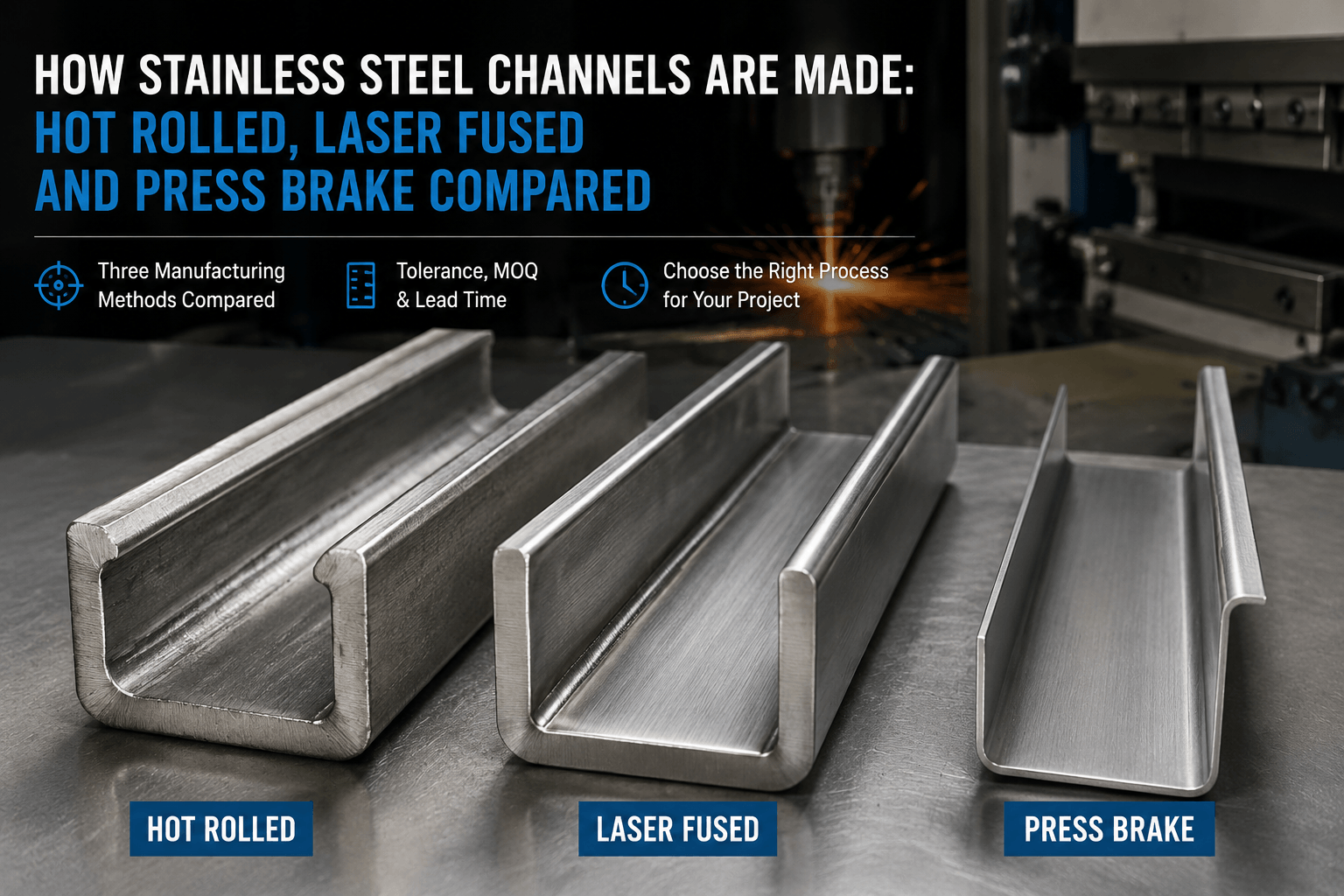
Stainless steel channels can be manufactured through different processes, including hot rolling, laser fusion welding and press brake forming. Each manufacturing method provides different advantages in terms of dimensional accuracy, customization capability, production quantity and lead time.
For engineers and industrial buyers, selecting the correct stainless steel channel manufacturing process is important because the production method directly affects profile availability, tolerances, surface condition and overall project cost.
Standard hot rolled channels are commonly used for large structural projects, while laser fused stainless steel channels are preferred for customized profiles with tight dimensional requirements. Press brake channels provide flexibility for small quantities and special fabrication requirements.
Quick Answer: Which Stainless Steel Channel Manufacturing Method Should You Choose?
- Hot Rolled Stainless Steel Channel:
Best for standard sizes, large volume orders and structural applications. - Laser Fused Stainless Steel Channel:
Best for customized dimensions, precise tolerances and special stainless steel profiles. - Press Brake Stainless Steel Channel:
Best for small batches, prototypes and flexible fabrication requirements.
Overview of Stainless Steel Channel Manufacturing Methods
A stainless steel channel is a structural profile with a U-shaped cross section consisting of a web and two flanges. Depending on the required size, application and production quantity, manufacturers may use different forming technologies.
The three common manufacturing methods are:
| Manufacturing Method | Basic Process | Typical Application |
|---|---|---|
| Hot Rolled | Heated stainless steel billet formed through rolling mills | Standard structural channels and large projects |
| Laser Fused | Laser welding stainless steel sections into customized profiles | Custom channels and precision applications |
| Press Brake | Cutting and bending stainless steel plate into channel shapes | Small batches and special dimensions |
How Hot Rolled Stainless Steel Channels Are Made
Hot rolling is one of the traditional methods for producing stainless steel structural profiles. The process starts with stainless steel billets that are heated to high temperatures and passed through a series of rolling stands to achieve the required channel shape.
The rolling process allows manufacturers to produce large quantities of standard channel sizes efficiently.
Hot Rolled Channel Manufacturing Process
- Stainless steel billet preparation
- High temperature heating
- Rolling through forming mills
- Cooling and straightening
- Cutting and inspection
Advantages of Hot Rolled Stainless Steel Channels
- Suitable for standard channel dimensions
- Efficient for high volume production
- Good structural performance
- Widely available in common sizes
Limitations of Hot Rolled Channels
- Limited customization compared with laser fused channels
- Higher minimum order requirements for special sizes
- Less flexibility for unique profile designs
How Laser Fused Stainless Steel Channels Are Made
Laser fused stainless steel channels are produced by cutting stainless steel plates or strips into required sections and joining them through precision laser welding technology.
This process allows manufacturers to produce customized channel profiles that may not be available through traditional hot rolling.
Laser Fusion Manufacturing Process
- Selection of stainless steel plate or strip
- Precision laser cutting
- Positioning of channel components
- Laser welding with controlled heat input
- Surface finishing and inspection
Advantages of Laser Fused Stainless Steel Channels
Laser fused stainless steel channels provide greater flexibility compared with traditional rolling processes. Because the profile is created by joining precisely cut stainless steel sections, manufacturers can produce channels with customized dimensions and optimized designs.
- Suitable for non-standard channel dimensions
- Better dimensional control
- Sharp and accurate corner geometry
- Lower heat input compared with traditional welding methods
- Suitable for stainless steel grades requiring corrosion resistance
- Flexible production for customized projects
Applications of Laser Fused Stainless Steel Channels
Laser fused channels are commonly used when standard hot rolled profiles cannot meet project requirements.
- Architectural stainless steel structures
- Food processing equipment
- Chemical processing systems
- Marine and offshore structures
- Customized industrial frames
- Special stainless steel fabrication projects
Need a Customized Stainless Steel Channel?
Laser fused stainless steel channels are suitable for projects requiring special dimensions, precise tolerances or customized profile designs.
Provide your drawing, stainless steel grade, dimensions and quantity requirements for a suitable manufacturing solution.
How Press Brake Stainless Steel Channels Are Made
Press brake forming is a flexible manufacturing method that uses stainless steel plates and bending equipment to create channel profiles.
Unlike hot rolling, press brake forming does not require dedicated rolling tools, making it suitable for small quantities and customized dimensions.
Press Brake Channel Manufacturing Process
- Stainless steel plate selection
- Plate cutting according to drawing requirements
- Precision bending using press brake equipment
- Welding or finishing when required
- Dimensional inspection
Advantages of Press Brake Stainless Steel Channels
- Low tooling requirements
- Suitable for small batch production
- Fast production for customized sizes
- Flexible material thickness selection
Limitations of Press Brake Channels
- Limited by bending capability and equipment size
- Corner geometry differs from rolled profiles
- Large volume production may be less efficient
Hot Rolled vs Laser Fused vs Press Brake Stainless Steel Channels
The best manufacturing method depends on required dimensions, order quantity, tolerance requirements and application conditions.
| Feature | Hot Rolled | Laser Fused | Press Brake |
|---|---|---|---|
| Raw Material | Billet | Plate or strip | Plate |
| Production Method | Rolling | Laser welding | Bending |
| Standard Sizes | Excellent | Good | Limited |
| Custom Dimensions | Limited | Excellent | Excellent |
| Typical MOQ | Large quantity | Medium quantity | Small quantity possible |
| Lead Time | Depends on standard availability | Medium | Usually shorter for custom orders |
Tolerance and Surface Comparison
Manufacturing method influences dimensional accuracy, surface appearance and post-processing requirements.
| Factor | Hot Rolled | Laser Fused | Press Brake |
|---|---|---|---|
| Dimensional Control | Suitable for standard profiles | Higher precision | Depends on bending accuracy |
| Corner Shape | Rolled profile corners | Sharp welded corners | Bent corners |
| Surface Condition | Rolled surface | Can be finished according to requirements | Plate surface condition maintained |
ASTM A1069 Laser Fused Stainless Steel Structural Shapes
ASTM A1069 is a specification related to laser fused stainless steel structural shapes. It provides requirements for laser fused sections manufactured from stainless steel plates or other stainless steel components.
Unlike traditional hot rolled profiles, laser fused stainless steel channels are produced by precision cutting and laser welding processes, allowing manufacturers to create customized structural shapes that meet specific project requirements.
| Item | Laser Fused Stainless Steel Channel |
|---|---|
| Manufacturing Method | Laser welding of stainless steel sections |
| Profile Capability | Customized channels and special structural profiles |
| Material Selection | 304, 316 and other stainless steel grades |
| Typical Applications | Architectural, industrial and corrosion-resistant structures |
For projects requiring customized stainless steel channels, buyers should confirm material grade, dimensions, welding requirements, surface finish and inspection requirements before production.
How to Choose the Right Stainless Steel Channel Manufacturing Method
The correct manufacturing method depends on project requirements rather than one process being universally better. Buyers should consider profile availability, quantity, dimensional requirements and application environment.
| Project Requirement | Recommended Manufacturing Method |
|---|---|
| Standard channel sizes and large quantities | Hot Rolled Channel |
| Customized dimensions and tight tolerances | Laser Fused Channel |
| Small quantity or prototype requirements | Press Brake Channel |
| Architectural stainless steel structures | Laser Fused or Press Brake |
Applications of Different Stainless Steel Channel Manufacturing Processes
| Industry | Suitable Manufacturing Method | Reason |
|---|---|---|
| Structural Engineering | Hot Rolled | Standard sizes and high production efficiency |
| Food Processing Equipment | Laser Fused | Customized corrosion-resistant profiles |
| Architectural Projects | Laser Fused / Press Brake | Design flexibility and appearance requirements |
| Custom Fabrication | Press Brake | Flexible production for special sizes |
Request a Stainless Steel Channel Solution
If you require a standard stainless steel channel or a customized laser fused channel, provide your material grade, dimensions, quantity and application requirements for evaluation.
Available solutions include stainless steel channels, custom welded profiles and fabricated stainless steel sections.
FAQ
What is a laser fused stainless steel channel?
A laser fused stainless steel channel is a channel profile manufactured by laser welding stainless steel sections together to achieve customized dimensions and precise structural requirements.
Are laser fused channels stronger than hot rolled channels?
Both manufacturing methods can produce reliable stainless steel channels. The suitable choice depends on design requirements, dimensions, tolerances and application conditions.
What is ASTM A1069?
ASTM A1069 is a specification associated with laser fused stainless steel structural shapes, including requirements related to manufacturing and product quality.
Which stainless steel channel process is best for custom sizes?
Laser fused and press brake processes are generally more suitable for customized channel dimensions because they provide greater production flexibility.
Can stainless steel channels be made from 316 stainless steel?
Yes. Stainless steel channels can be produced using grades such as 304 and 316 depending on corrosion resistance requirements and application conditions.
Related Stainless Steel Channel Products
- Stainless Steel Channel Bar
- Laser Fused Stainless Steel Channel
- 304 Stainless Steel Channel
- 316 Stainless Steel Channel
- Custom Stainless Steel Profiles
- Stainless Steel Angle Bar
For quotation requests, please provide channel type, stainless steel grade, dimensions, quantity, required standard and application information.
Conclusion
Hot rolled, laser fused and press brake are three common methods for manufacturing stainless steel channels. Each process has its own advantages depending on production volume, dimensional requirements and application needs.
Hot rolled channels are suitable for standard structural applications, laser fused channels provide flexibility for customized and precision profiles, and press brake channels offer an efficient solution for smaller quantities and special dimensions.
Understanding these manufacturing differences helps engineers and buyers select the right stainless steel channel solution for their projects.
Post time: Jul-31-2026