Introduction
Stainless steel angles can be manufactured through different production methods, with laser fused and hot rolled being two common approaches for industrial and architectural applications.
Although both processes produce L-shaped stainless steel profiles, they have significant differences in edge sharpness, corner radius, dimensional tolerance, surface appearance, production flexibility and application suitability.
Choosing between laser fused stainless steel angles and hot rolled stainless steel angles depends on project requirements, including structural performance, visible appearance, size customization and production quantity.
Quick Answer: Laser Fused vs Hot Rolled Stainless Steel Angle
- Choose laser fused stainless steel angles when sharp edges, precise dimensions, clean appearance and customized sizes are required.
- Choose hot rolled stainless steel angles for standard sizes, heavy structures and cost-effective large volume projects.
- Laser fused angles usually provide better dimensional flexibility, while hot rolled angles are commonly selected for structural applications.
Laser Fused Stainless Steel Angle
Laser fused stainless steel angles are manufactured by joining individual stainless steel plates using a high-precision laser welding process.
Unlike traditional rolled profiles, laser fused angles allow manufacturers to combine different plate thicknesses and produce customized dimensions that may not be available from standard rolling mills.
This manufacturing method is widely used in architectural structures, precision fabrication and applications where appearance and dimensional accuracy are important.
Advantages of Laser Fused Stainless Steel Angles
| Feature | Benefit |
|---|---|
| Sharp Edge Condition | Produces cleaner and sharper corners compared with traditional rolled angles |
| Dimensional Flexibility | Allows customized leg sizes, thickness combinations and special dimensions |
| Surface Appearance | Suitable for visible architectural applications requiring clean finishes |
| Small Production Quantity | More flexible for customized or smaller batch production |
Hot Rolled Stainless Steel Angle
Hot rolled stainless steel angles are produced by heating stainless steel billets and forming them through rolling processes.
This traditional manufacturing method is widely used for standard stainless steel structural angles because of its efficient production capability and availability in common sizes.
Hot rolled angles are commonly selected for structural applications where load capacity, availability and cost efficiency are the main considerations.
Advantages of Hot Rolled Stainless Steel Angles
| Feature | Benefit |
|---|---|
| Structural Performance | Suitable for heavy-duty structural applications |
| Standard Availability | Common sizes are easier to source |
| Production Efficiency | Economical for larger quantity orders |
Laser Fused vs Hot Rolled Stainless Steel Angle Comparison
The manufacturing process has a direct impact on stainless steel angle performance, appearance and purchasing requirements. The following comparison highlights the main differences between laser fused and hot rolled stainless steel angles.
| Feature | Laser Fused Stainless Angle | Hot Rolled Stainless Angle |
|---|---|---|
| Manufacturing Process | Laser welding of precision-cut stainless steel plates | Rolling heated stainless steel billets into angle profiles |
| Edge Sharpness | Sharper and cleaner edges with controlled geometry | More rounded edges due to rolling process |
| Corner Radius | Small and controlled corner radius | Larger natural rolling radius |
| Dimensional Tolerance | Higher dimensional accuracy and flexibility | Standard rolling tolerances |
| Surface Finish | Suitable for polished and architectural applications | Typical mill finish after hot rolling |
| Size Customization | High flexibility for special dimensions | Limited to available rolling sizes |
| Minimum Order Quantity | More suitable for customized and smaller batch production | Usually more economical for larger quantities |
Edge Sharpness and Corner Radius Comparison
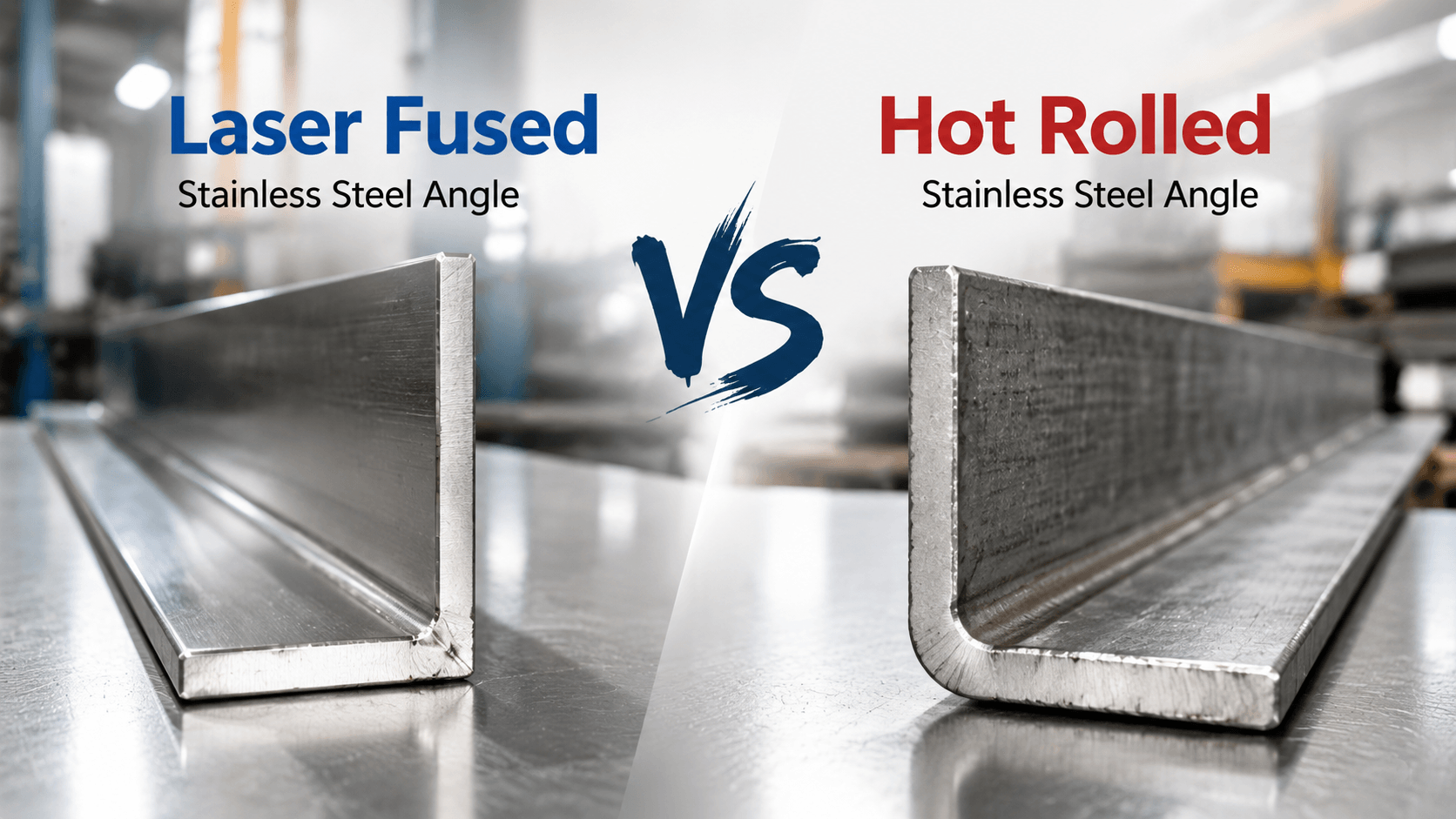
One of the most visible differences between laser fused and hot rolled stainless steel angles is the edge condition and corner geometry.
Laser fused stainless steel angles are manufactured by joining precision-cut plates, which allows better control of corner dimensions. This makes them suitable for applications where clean lines and sharp edges are required.
Hot rolled stainless steel angles are formed through rolling processes. The rolling deformation naturally creates larger corner radii and softer edges, which are acceptable for many structural applications.
| Requirement | Recommended Choice |
|---|---|
| Sharp visible corners | Laser fused stainless angle |
| Architectural appearance | Laser fused stainless angle |
| Heavy structural support | Hot rolled stainless angle |
Dimensional Tolerance and Accuracy
Dimensional tolerance is an important consideration when stainless steel angles are used for precision fabrication, architectural structures or assemblies requiring accurate fitting.
Laser fused angles generally provide tighter dimensional control because the profile is produced from precision-cut plates and controlled welding processes.
Hot rolled angles follow standard rolling tolerances and are commonly selected when standard structural requirements are acceptable.
Surface Finish Difference
Surface requirements often determine the choice between laser fused and hot rolled stainless steel angles.
| Surface Requirement | Suitable Process |
|---|---|
| Visible architectural structure | Laser fused |
| Polished stainless applications | Laser fused |
| General industrial structures | Hot rolled |
MOQ and Production Flexibility
Minimum order quantity and production flexibility are also important factors when selecting a manufacturing method.
Hot rolled stainless steel angles are usually more cost-effective for standard dimensions and larger production quantities because rolling mills produce fixed profiles efficiently.
Laser fused stainless steel angles provide greater flexibility for custom dimensions, special thickness combinations and projects requiring smaller production quantities.
ASTM A1069/A1069M Standard for Laser Fused Stainless Steel Shapes
ASTM A1069/A1069M is a specification covering laser fused stainless steel structural shapes. It provides requirements related to manufacturing, dimensions, tolerances and material quality for laser fused profiles.
For projects requiring customized stainless steel angles, architectural stainless structures or precision-fabricated shapes, ASTM A1069 is commonly referenced to define product requirements.
| Item | ASTM A1069/A1069M Focus |
|---|---|
| Manufacturing Method | Laser fusion of stainless steel components |
| Product Type | Stainless steel structural shapes including customized profiles |
| Dimensional Control | Requirements for profile dimensions and tolerances |
| Applications | Architectural, industrial and precision structural applications |
Which Stainless Steel Angle Should You Specify?
The correct choice between laser fused and hot rolled stainless steel angles depends on the project requirements rather than the manufacturing method alone.
| Project Requirement | Recommended Choice |
|---|---|
| Sharp corners and clean appearance | Laser fused stainless steel angle |
| Architectural visible structures | Laser fused stainless steel angle |
| Custom dimensions or special sizes | Laser fused stainless steel angle |
| Standard structural applications | Hot rolled stainless steel angle |
| Large quantity projects with standard sizes | Hot rolled stainless steel angle |
Applications of Laser Fused and Hot Rolled Stainless Steel Angles
Both manufacturing methods serve different application requirements. The selection should consider appearance, mechanical requirements, manufacturing efficiency and project specifications.
- Architectural Structures: Laser fused angles are commonly selected for visible stainless steel frameworks, decorative structures and modern architectural designs.
- Industrial Equipment: Hot rolled angles are widely used for machine frames, supports and general structural components.
- Food and Pharmaceutical Equipment: Stainless steel angles with clean surfaces and corrosion resistance are used in sanitary environments.
- Marine Applications: Stainless steel angles are selected where corrosion resistance and long service life are required.
FAQ
What is a laser fused stainless steel angle?
A laser fused stainless steel angle is an L-shaped stainless steel profile manufactured by joining precision-cut stainless steel plates through laser fusion welding.
What is the difference between laser fused and hot rolled stainless steel angles?
Laser fused stainless steel angles provide better dimensional flexibility, sharper edges and controlled corner geometry, while hot rolled stainless steel angles are commonly selected for standard sizes and structural applications.
Are laser fused stainless steel angles stronger than hot rolled angles?
Strength depends on material grade, dimensions, design and application requirements. Laser fused and hot rolled angles are manufactured for different purposes rather than one being universally stronger.
Why are laser fused stainless angles used in architecture?
Laser fused stainless angles provide cleaner edges, tighter dimensional control and better appearance, making them suitable for visible architectural structures.
What standard covers laser fused stainless steel shapes?
ASTM A1069/A1069M is a commonly referenced specification for laser fused stainless steel structural shapes.
Laser Fused and Hot Rolled Stainless Steel Angles from SAKY STEEL
SAKY STEEL supplies stainless steel angles for architectural, industrial and customized fabrication projects.
Available solutions include standard hot rolled stainless steel angles and customized laser fused stainless steel angles according to project requirements.
Products can be supplied with different stainless steel grades, dimensions, surface finishes and inspection documents.
For quotation requests, please provide:
- Stainless steel grade
- Angle dimensions
- Manufacturing method preference
- Quantity requirement
- Application details
Conclusion
Laser fused and hot rolled stainless steel angles are both valuable solutions for different engineering requirements. Laser fused angles provide advantages in customization, edge quality and dimensional control, while hot rolled angles remain an efficient choice for standard structural applications.
By understanding the differences in manufacturing process, tolerance, surface finish and application requirements, engineers and buyers can select the most suitable stainless steel angle for their projects.
Post time: Jul-29-2026