Pearlite vs Bainite vs Martensite: How Heat Treatment Changes Steel Microstructure
The same piece of steel can become easier to machine, harder, stronger, tougher or more dimensionally stable depending on how it is heated, held and cooled. The reason is not that heat treatment changes the external shape of the bar or component. It changes the internal microstructure.
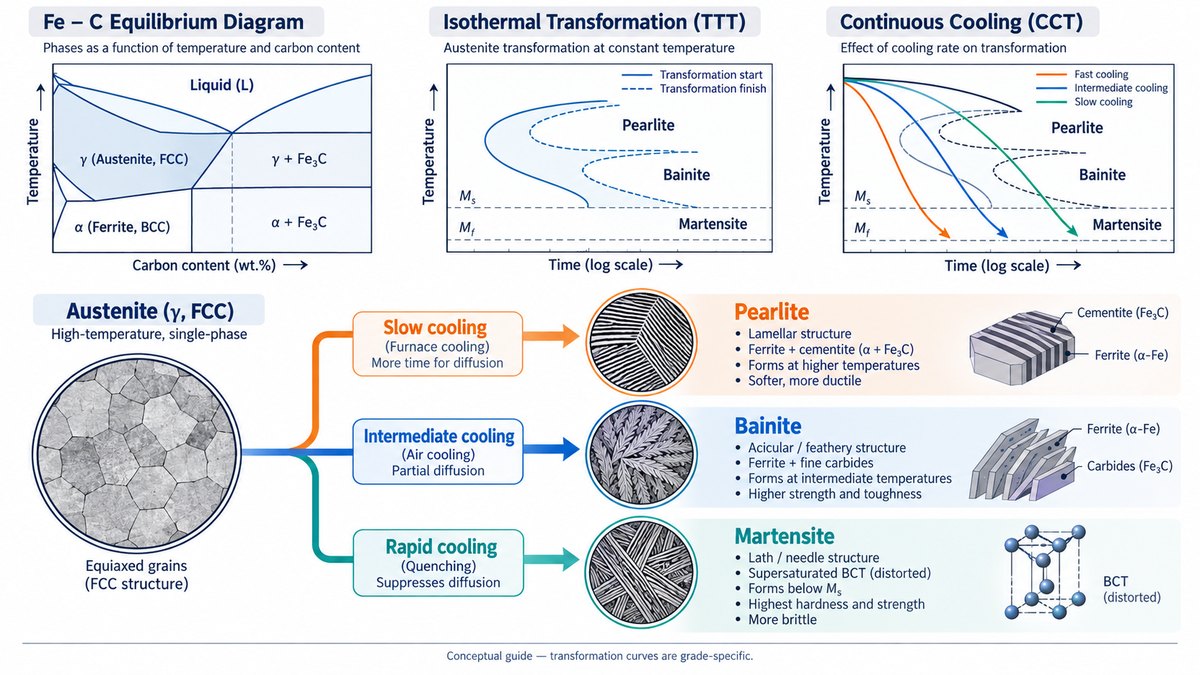
A useful first approximation is that steel is heated to create an appropriate austenitic starting structure and then cooled along a controlled path. Depending on composition, austenitizing condition, time, cooling rate and section size, the austenite may transform into ferrite and pearlite, bainite, martensite, retained austenite or a mixture of several constituents.
Pearlite forms through carbon diffusion and consists of ferrite and cementite, usually in a lamellar arrangement. Bainite forms in an intermediate temperature range and has a finer ferritic structure with carbon redistribution or carbide precipitation that depends on the steel and transformation conditions. Martensite forms when austenite is cooled below the martensite-start temperature without first undergoing sufficient diffusional transformation. It is normally the hardest as-quenched constituent, but it also carries high internal stress and is commonly tempered before service.
1. Start with the Correct Metallurgical Language
Ferrite and austenite are solid-solution phases based on different crystal structures of iron. Cementite, Fe3C, is a hard and brittle iron carbide. Pearlite and bainite are microstructural constituents containing more than one phase. Martensite is a metastable transformation product formed from austenite without the long-range diffusion of carbon that is required for pearlite formation.
| Name | Metallurgical Description | Typical Characteristics | Important Caution |
|---|---|---|---|
| Ferrite | Carbon in alpha iron; body-centred cubic structure | Relatively soft and ductile; low carbon solubility | Ferrite content depends on composition and thermal history |
| Austenite | Carbon in gamma iron; face-centred cubic structure | High carbon solubility; key parent phase for many heat treatments | Can be stable at room temperature in some alloy systems |
| Cementite | Iron carbide, Fe3C | Hard and brittle | Size, shape and distribution strongly affect properties |
| Pearlite | Ferrite plus cementite, commonly lamellar | Machinable balance of strength and ductility | Fine pearlite is generally harder and stronger than coarse pearlite |
| Bainite | Fine ferritic transformation product with carbon redistribution and, in many steels, carbides | Can provide a useful strength–toughness combination | Not simply a mixture of pearlite and martensite |
| Martensite | Diffusionless transformation product of austenite | High as-quenched hardness and strength | Usually requires tempering to control stress and brittleness |
Plant personnel often refer to all of these as “metallographic structures.” That wording is convenient in daily communication, but separating phases, compounds and microstructural constituents helps prevent incorrect conclusions when interpreting heat-treatment results.
2. Austenite Is the Starting Point
Most annealing, normalizing, quenching and austempering routes for carbon and low-alloy steels depend on creating a suitable austenitic starting structure. Austenite has a face-centred cubic crystal structure and can dissolve substantially more carbon than ferrite. When the steel is cooled, that high-temperature austenite is no longer stable under the new conditions and begins to transform.
Austenitizing is not simply heating steel until it glows. The steel has to reach an appropriate temperature and remain there long enough for the required transformation and carbon redistribution to occur. Insufficient heating may leave unwanted ferrite or undissolved carbides. Excessive temperature or holding time can coarsen the prior-austenite grain size, increase oxidation and decarburization risk, and change subsequent transformation behavior.
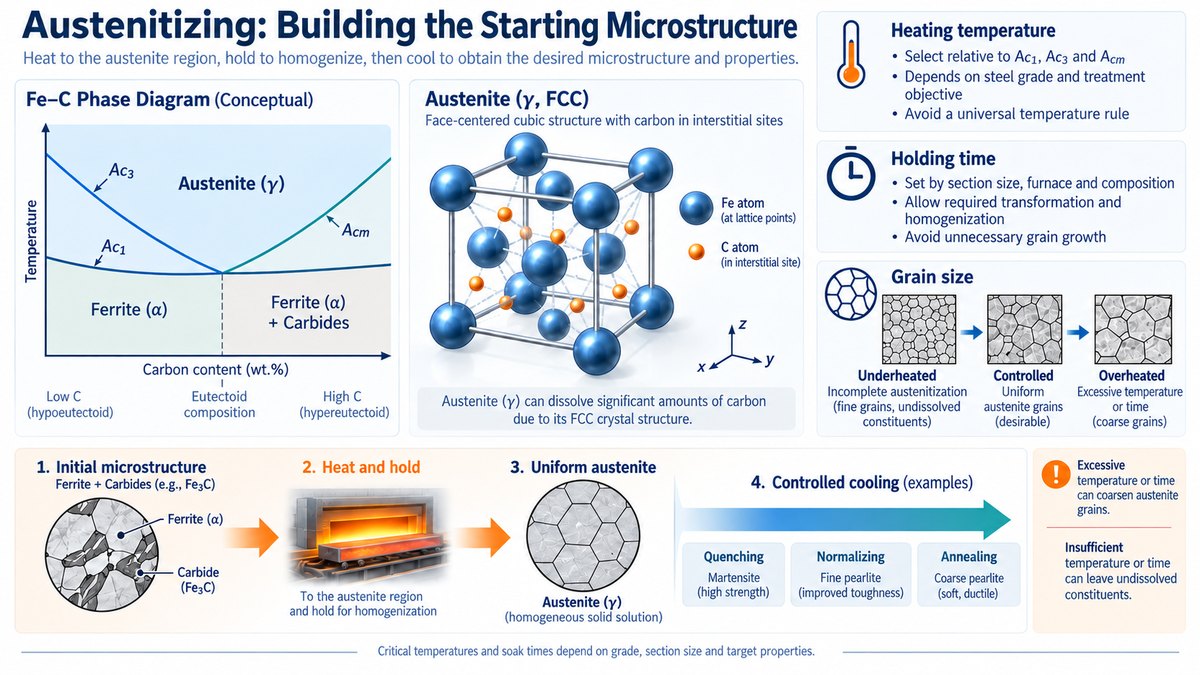
For hypoeutectoid steels, complete austenitization normally requires heating above the relevant upper critical temperature. For hypereutectoid steels, the selected temperature depends on whether the process is intended to dissolve all carbides or retain a controlled fraction of undissolved carbides. A fixed temperature copied from another steel grade should never replace the approved process specification.
3. Iron–Carbon, TTT and CCT Diagrams Answer Different Questions
Three diagram types are commonly used to understand steel transformations, but they are not interchangeable.
| Diagram | What It Shows | How It Is Used | Main Limitation |
|---|---|---|---|
| Iron–carbon diagram | Equilibrium phase relationships versus temperature and carbon content | Identifying critical regions and equilibrium phases | Does not directly show transformation time or industrial cooling kinetics |
| TTT diagram | Transformation start and finish during isothermal holding | Understanding isothermal transformation and austempering windows | Does not directly reproduce continuous industrial cooling |
| CCT diagram | Transformation during continuous cooling at different rates | Selecting cooling paths for normalizing, quenching and practical production | Valid only for the composition and austenitizing conditions used to develop the diagram |
4. Pearlite: Diffusion-Controlled Lamellar Transformation
When austenite transforms at relatively high temperature and sufficient time is available for carbon diffusion, pearlite can form. Pearlite is normally a lamellar aggregate of ferrite and cementite. Carbon moves away from growing ferrite and contributes to adjacent cementite formation, producing alternating layers.
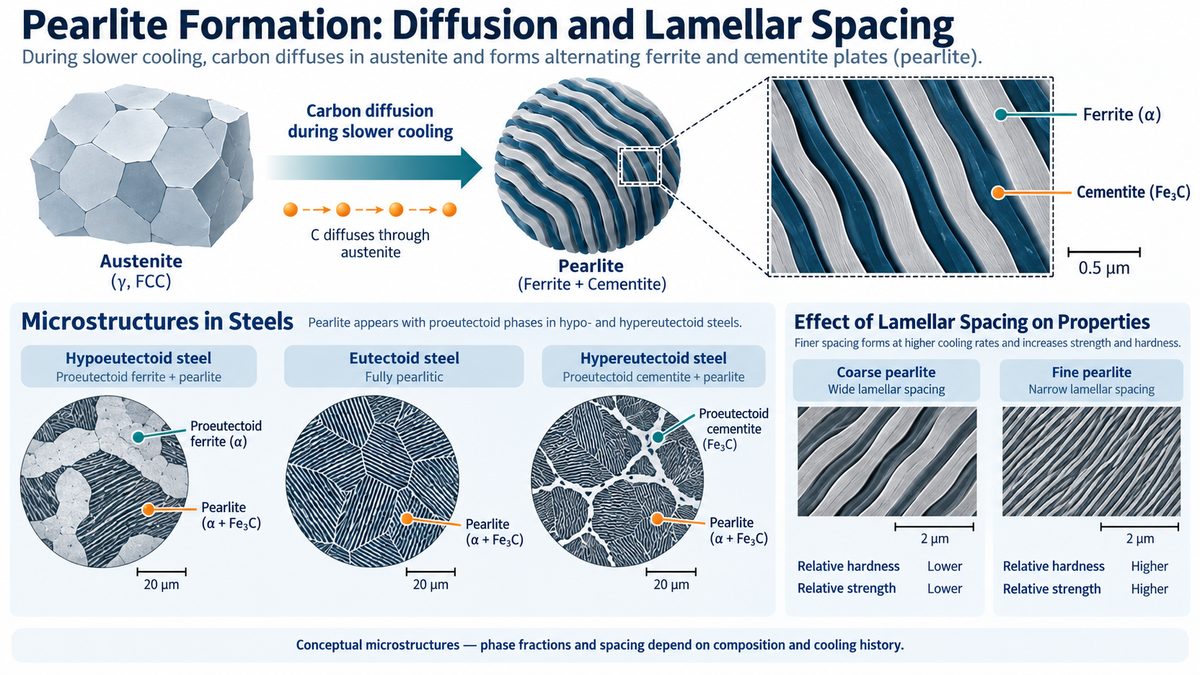
Higher transformation temperatures generally produce coarser pearlite with wider lamellar spacing. Lower transformation temperatures produce finer pearlite. Within the same steel and at comparable phase fractions, fine pearlite is generally stronger and harder than coarse pearlite because its ferrite–cementite spacing is smaller.
Slow cooling does not mean that every steel becomes 100% pearlite. A hypoeutectoid steel usually forms proeutectoid ferrite before the remaining austenite transforms to pearlite. A hypereutectoid steel may form proeutectoid cementite before pearlite. The final structure therefore depends on both carbon content and cooling path.
5. Bainite: An Intermediate-Temperature Transformation Product
If austenite is transformed below the pearlite range but above the temperature at which martensite begins to form, bainite may develop. Bainite is not simply a physical mixture of pearlite and martensite. It has its own transformation range, morphology and property balance.
Classical descriptions separate upper and lower bainite. Upper bainite forms at the higher part of the bainitic range and commonly contains sheaves of ferritic laths with carbides concentrated between laths. Lower bainite forms at lower temperature, is finer and can contain carbides within the ferritic units as well as at their boundaries. The exact morphology changes with composition, transformation temperature and alloy design.
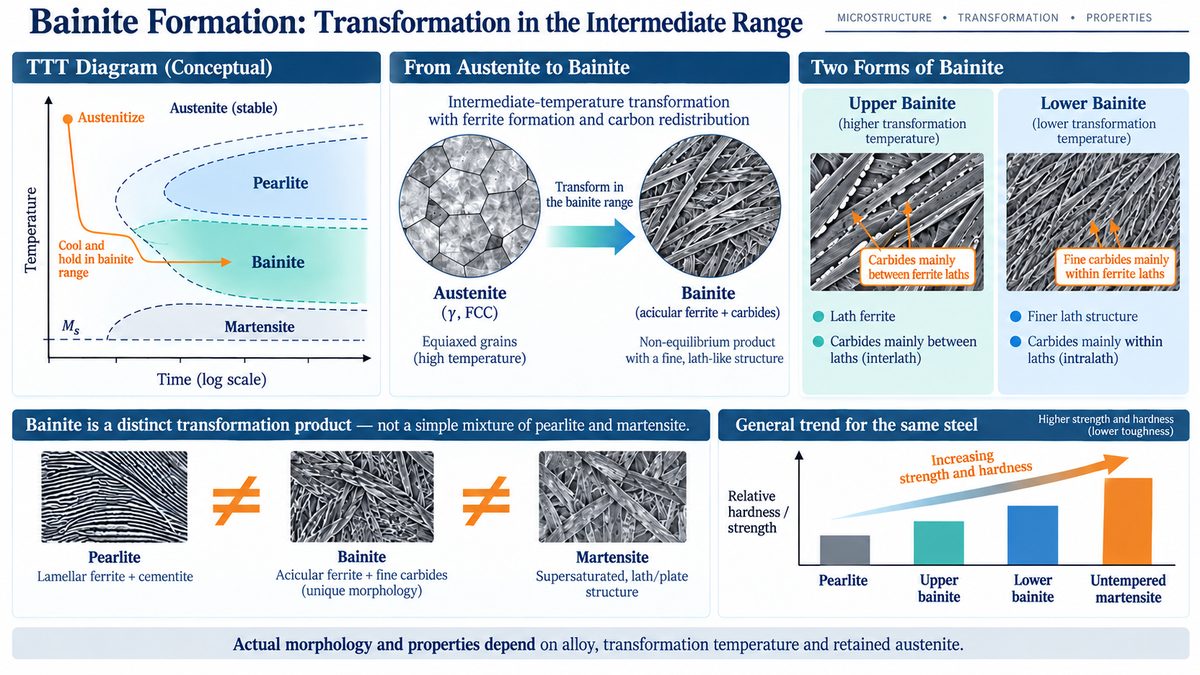
In many conventional carbon and low-alloy steels, lower bainite can provide higher hardness and strength than pearlite while retaining better toughness than untempered high-carbon martensite. This is a trend rather than a universal ranking. Carbide-free bainitic steels, silicon-alloyed grades and structures containing carbon-enriched retained austenite require a different interpretation.
6. Martensite: Rapid, Diffusionless Transformation
If the cooling path avoids significant ferrite, pearlite and bainite formation, austenite can reach the martensite-start temperature, Ms. Below Ms, martensite begins to form through a coordinated displacement of atoms rather than long-range carbon diffusion. Carbon becomes trapped in supersaturated solid solution, producing severe lattice strain, high dislocation density and internal stress.
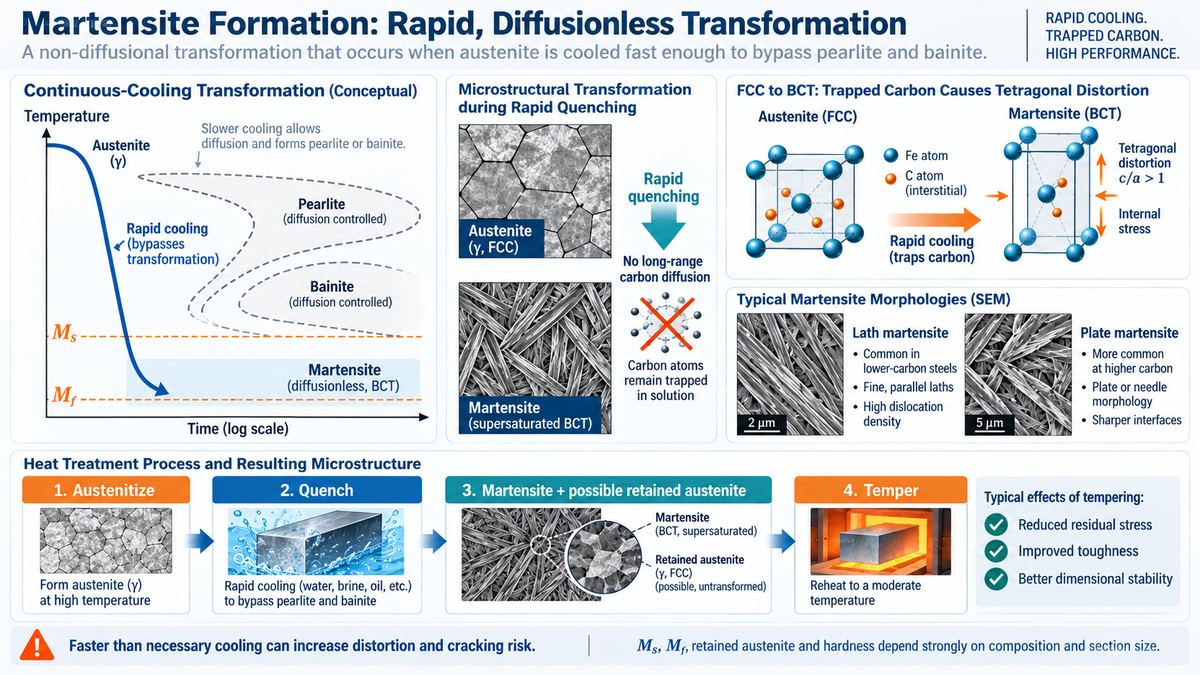
Martensitic transformation in many steels is largely athermal: the fraction transformed is governed mainly by the lowest temperature reached below Ms, not by holding indefinitely at a single temperature. If the martensite-finish temperature, Mf, lies below room temperature, retained austenite may remain and affect hardness, dimensional stability and service behavior.
Low-carbon martensite is commonly lath-like and can retain useful toughness. With increasing carbon content, plate martensite becomes more prominent, achievable hardness increases and the risks of brittleness, distortion and quench cracking also increase. Cooling faster than necessary does not make a fully martensitic part infinitely harder; it can simply increase thermal and transformation stresses.
For this reason, quenching is normally followed promptly by tempering. Tempering permits carbon redistribution and carbide precipitation, reduces residual stress and allows strength, hardness and toughness to be adjusted toward a practical service condition.
7. Pearlite vs Bainite vs Martensite
| Comparison | Pearlite | Bainite | Martensite, As-Quenched |
|---|---|---|---|
| Formation range | Relatively high transformation temperature | Intermediate temperature | Below Ms |
| Carbon movement | Long-range diffusion required | Carbon redistributes during or after ferritic transformation; mechanism depends on condition | No long-range diffusion during transformation |
| Typical morphology | Ferrite–cementite lamellae | Fine laths, plates or sheaves with carbon-enriched regions or carbides | Laths or plates |
| Relative hardness trend | Coarse pearlite lower; fine pearlite higher | Often between pearlite and untempered martensite | Usually highest for the same steel |
| Typical engineering objective | Machinability and balanced general properties | Strength–toughness balance and reduced distortion in selected routes | High hardenability response, followed by tempering for service |
For the same steel at similar constituent fractions, a common untempered hardness trend is:
This ranking must not be used to compare unrelated steel grades. Carbon content, alloying, grain size, constituent fraction, retained austenite and tempering condition can change the result. Tempered martensite may have lower hardness but much better toughness than the as-quenched structure.
8. Hardening Capacity Is Not the Same as Hardenability
Hardening capacity, sometimes called maximum attainable hardness or quench hardness, describes how hard a steel can become after suitable quenching. Carbon content is a major controlling factor.
Hardenability describes the ability of a steel to form a required depth of martensitic or hardened structure under specified quenching conditions. Alloy content, austenite grain size, prior structure, quenching medium, agitation, part geometry and section size all influence the hardened depth.
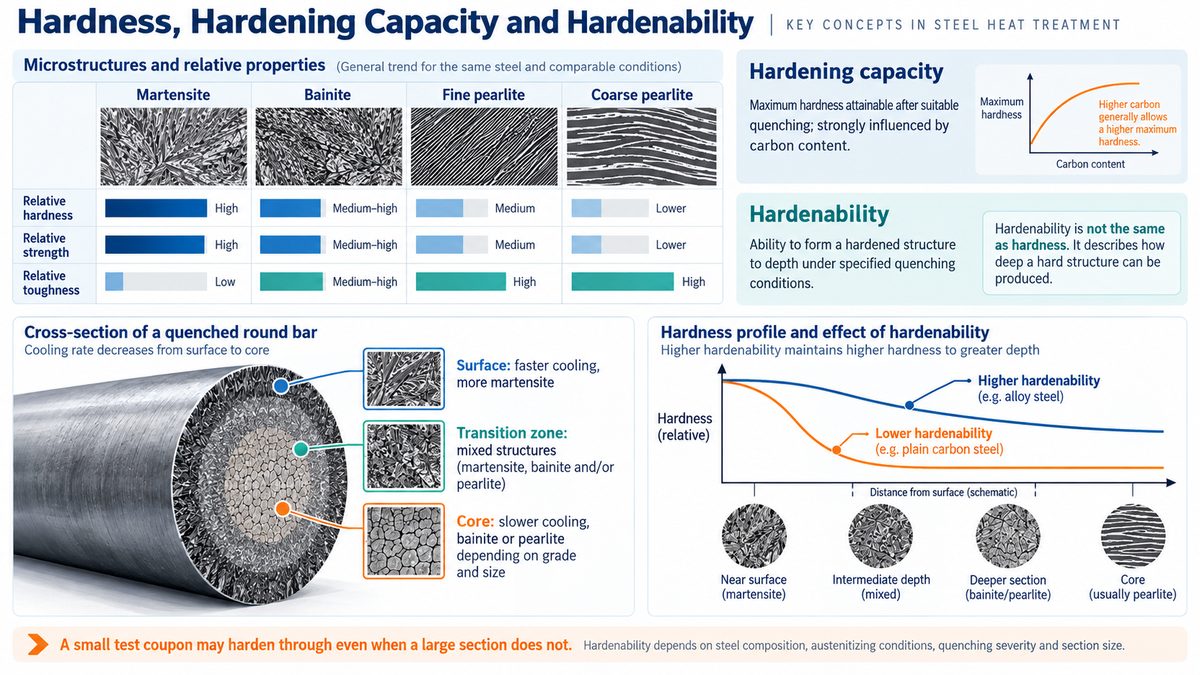
A small laboratory specimen may cool quickly enough to become nearly fully martensitic, while the centre of a large bar cools much more slowly. The large bar can consequently contain martensite near the surface, a bainitic transition region and pearlite or mixed constituents at the core. Surface hardness alone cannot prove through-section properties.
Critical components may therefore require a combination of surface and core hardness testing, tensile testing, impact testing, metallographic examination, ultrasonic testing, dimensional inspection and review of the heat-treatment chart.
9. How to Select a Heat-Treatment Route
A practical heat-treatment review can be organized around four questions:
- What is the material? Carbon and alloy content determine critical temperatures, hardenability, Ms, Mf and the location of the transformation curves.
- Was the austenite prepared correctly? Heating temperature, holding time, grain size and carbide dissolution determine the starting condition for all subsequent transformations.
- Where does the actual cooling curve travel? The relationship between the component’s cooling curve and the grade-specific CCT or TTT diagram controls the transformation products.
- Is tempering or another subsequent treatment required? As-quenched martensite is rarely the complete engineering solution.
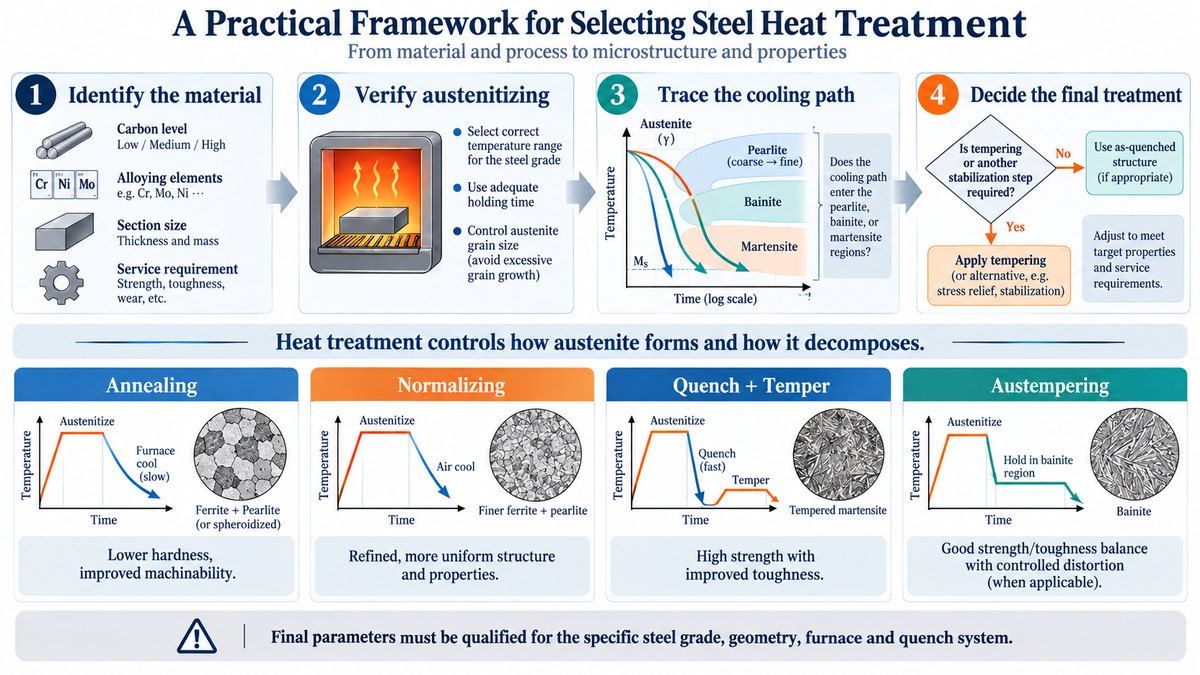
| Process | General Route | Common Objective | Possible Final Structure |
|---|---|---|---|
| Annealing | Heat and cool slowly using a grade-specific cycle | Lower hardness, improve machinability, relieve stress or prepare for further treatment | Ferrite plus pearlite, spheroidized carbides or another near-equilibrium structure |
| Normalizing | Austenitize and air cool | Refine structure and obtain higher strength than a comparable full anneal | Often ferrite plus finer pearlite; grade and section dependent |
| Quench and temper | Austenitize, quench, then reheat below the lower critical temperature | Develop high strength while reducing quench stress and improving toughness | Tempered martensite, possibly with other constituents |
| Austempering | Quench to a bainitic temperature above Ms, hold for transformation, then cool | Obtain bainite and potentially reduce distortion compared with a direct martensitic quench | Predominantly bainitic when the section and hardenability permit |
10. Practical Example: 4130 Alloy Steel Bar
AISI 4130 is a chromium–molybdenum low-alloy steel whose final properties depend strongly on product size and delivery condition. It may be supplied in an annealed or normalized condition for machining and forming, or heat treated to a specified quenched-and-tempered condition when higher strength is required.
A purchaser should not specify only “4130 bar” and assume that one property level applies to every diameter. The order should state the applicable material standard, diameter, surface condition, delivery condition, required mechanical properties, heat-treatment responsibility and testing requirements. Large-section properties and test location deserve particular attention because the centre cools more slowly than the surface.
Recommended RFQ information for heat-treatable steel bar:
- Steel grade and applicable product standard
- Bar shape, diameter or thickness, length and quantity
- Required delivery condition: annealed, normalized, quenched and tempered, or another specified condition
- Target tensile, yield, elongation, hardness and impact requirements where applicable
- Required test location and orientation for large sections
- Surface finish and dimensional tolerances
- Ultrasonic, metallographic, hardness-traverse, PMI or third-party inspection requirements
- Mill test certificate and heat-treatment documentation requirements
11. Important Boundary: These Rules Do Not Apply Identically to Every Stainless Steel
The transformation framework in this article is most directly applicable to carbon steels and many low-alloy steels. Austenitic stainless steels can retain austenite at room temperature because of their alloy design. Ferritic stainless steels do not transform through the same austenitic route under ordinary heat treatment. Martensitic stainless steels and precipitation-hardening grades have their own composition-dependent treatment cycles.
Heat treatment must therefore be based on the specific grade and product standard. A CCT diagram or quenching schedule for 4130 steel cannot be applied to 304 stainless steel, 17-4PH, tool steel or bearing steel simply because all are described as “steel.”
Frequently Asked Questions
Is martensite always harder than bainite and pearlite?
For the same steel in comparable untempered conditions, martensite is generally the hardest, followed by bainite and then fine and coarse pearlite. This is not a valid universal ranking across different compositions or after tempering.
Is bainite a mixture of pearlite and martensite?
No. Bainite is a distinct transformation product formed in its own temperature and time range. Its morphology and carbide distribution differ from both lamellar pearlite and martensite.
Does faster quenching always produce higher hardness?
Only until the required martensitic fraction is achieved. After the section is already substantially martensitic, extra quench severity may add distortion and cracking risk without a meaningful hardness gain.
What is retained austenite?
Retained austenite is austenite that remains untransformed after cooling. It can occur when Mf is below the final cooling temperature or when composition and local carbon enrichment stabilize austenite. Its effect depends on the amount, morphology, stability and service conditions.
Why can the surface and centre of a steel bar have different structures?
The surface loses heat faster than the centre. If the steel’s hardenability and the quench severity are insufficient for the section size, the surface may form martensite while the centre forms bainite, pearlite or a mixed structure.
What is the difference between TTT and CCT diagrams?
A TTT diagram describes transformation during isothermal holding. A CCT diagram describes transformation during continuous cooling and is normally more representative of furnace cooling, air cooling and quenching in production.
Why is tempering required after quenching?
Quenching can leave high internal stress, brittle untempered martensite and retained austenite. Tempering reduces stress and adjusts carbide precipitation, strength, hardness, ductility and toughness toward the required service balance.
Conclusion
The central logic of steel heat treatment is straightforward: prepare the austenite correctly, control its decomposition path and verify the final structure and properties. Pearlite forms when diffusion is comparatively available, bainite forms in an intermediate transformation range, and martensite forms by diffusionless transformation after sufficiently rapid cooling below Ms.
Real components are more complex than a single diagram. Chemistry, austenitizing condition, section size, quench severity and tempering all matter. For purchasing and quality control, the complete heat-treatment condition and required through-section properties should be stated rather than relying on a grade name or a surface-hardness reading alone.
For bar availability and heat-treatment documentation requirements, review our 4130 Alloy Steel Bar page or contact Saky Steel.
Post time: Oct-16-2026