Quick answer. Yes, rolling direction can influence sheet bendability. A bend axis across the rolling direction is often a useful starting point for demanding bends. It is not a universal pass/fail rule: grade, supplied condition, thickness, radius and edge quality must be considered together. Define the bend axis explicitly before cutting the blank.
Which direction are we talking about?
The rolling direction (RD) follows the material through rolling. The bend axis is the line about which the flat blank will fold. Saying only “bend across the grain” can leave the orientation open to interpretation. Show an RD arrow and each bend axis on the flat-pattern drawing instead.
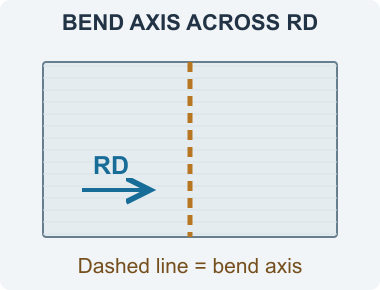
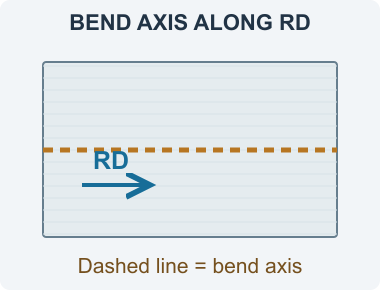
Diagram note. These are orientation definitions, not approved bend layouts. RD means rolling direction; the dashed line shows the bend axis. Neither sketch assigns a minimum radius or certifies a part.
Why the material condition changes the answer
Annealed austenitic stainless sheet can be highly formable. IMOA’s fabrication guidance describes tight-bend acceptance examples for standard annealed austenitic grades that do not depend on rolling direction, while stronger or temper-rolled material requires different limits. A direction rule taken from another alloy or condition can therefore be misleading.
The same grade name does not describe every forming condition. A cold-worked sheet may respond differently from an annealed sheet. Grade and thickness changes can also alter springback, so a setup that produced the right angle on the previous job may need adjustment. Confirm the intended material condition with the fabricator.
For a grade-specific starting-material example, see 316 stainless steel sheet. Grade selection and corrosion suitability remain separate from approval of a particular bend geometry.
When the layout needs another look
| Drawing or shop condition | What to resolve |
|---|---|
| A critical bend axis runs along RD | Review the grade, condition and proposed radius. If orientation is essential, preserve it in the nesting layout and validate a representative bend. |
| The part has bends in two directions | Mark the more demanding bend and review the other bend separately. A box-shaped part cannot place every bend axis across the same RD arrow. |
| Nesting is rotated to improve sheet yield | Check whether rotation changes a specified bend orientation or visible finish direction before releasing the revised layout. |
| The rolling direction is unknown | Request clarification of the parent material and any existing direction marking before cutting. Treat an unverified assumption as unresolved. |
Make the drawing readable before release
Use separate callouts for the material and the formed part. A practical review should identify:
- Grade, material specification, supplied condition and thickness.
- An RD arrow on the blank, with the relevant bend axes identified.
- Inside bend radius, finished angle and the applicable dimensional tolerances.
- Any visible face and required brushing or polishing direction.
- How a trial part or specified test will be evaluated before production approval.
An example note is: “Identify RD on the blank; retain the specified orientation of bend B1 during nesting. Confirm the proposed inside radius and finished angle before production.” Complete it with the actual drawing dimensions and agreed acceptance criteria; it is not a substitute for an engineering specification.
Two questions worth separating
Do visible brush lines prove the rolling direction?
Do not use the word “grain” as the only direction requirement. A directional surface finish controls appearance, while RD identifies the rolling orientation. Worldstainless guidance treats rolling and finishing direction as information that may need to be marked or agreed with the supplier. Confirm which direction a marking represents.
Does a bend-test report approve the production setup?
ASTM E290 covers defined bend tests for ductility. The method, specimen, orientation and acceptance requirement matter. A certificate or test result should be read against the ordered requirement; production tooling, geometry and the final part still need their own review.
If a trial cracks, review the edge and burr condition, radius, material condition and orientation together. Changing the blank direction alone does not establish the cause. Record the actual trial conditions so the next decision can be compared with the same starting point.
For the material side of the project, explore our stainless steel sheet products. Share the grade, thickness, finish, blank dimensions and any direction requirement when discussing the sheet order.
Post time: Nov-12-2026