Introduction
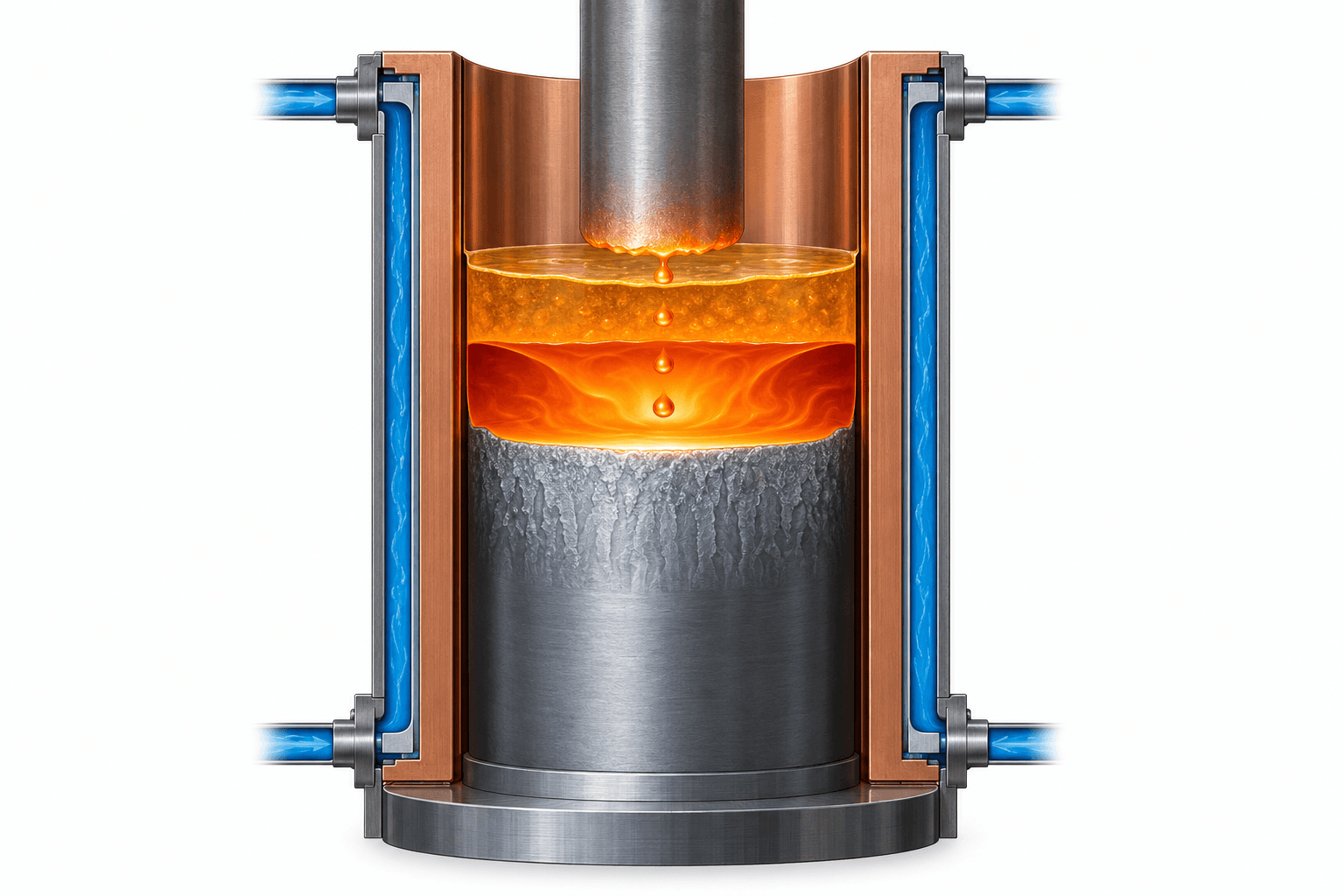
Electroslag remelting, commonly abbreviated as ESR, is a secondary remelting and refining process used to improve the cleanliness, homogeneity, solidification structure and internal soundness of selected steels and alloys. A previously melted metal electrode is remelted through an electrically heated slag bath, and the refined droplets solidify in a water-cooled mold.
For an engineer or buyer, the important point is that “ESR” describes a manufacturing route, not a steel grade. Two products may share the same nominal grade and specification while having different melting routes, inclusion characteristics, inspection requirements and prices. If a drawing, aerospace specification or customer standard requires ESR, conventional material should not be substituted without written engineering approval.
What Is Electroslag Remelting?
ESR normally follows a primary melting route. The consumable electrode may first be produced by an electric arc furnace route with secondary metallurgy, or by vacuum induction melting when alloy control and cleanliness requirements call for it. ESR then remelts that electrode under a molten slag layer.
The process should therefore be understood as:
Primary melting and electrode preparation → electroslag remelting → controlled ingot solidification → forging or rolling → heat treatment → inspection.
ESR is used when the required product quality justifies an additional remelting step. Common applications include tool and die steels, bearing steels, stainless and precipitation-hardening steels, high-strength alloy steels, heat-resistant steels and some nickel-based alloys. It is particularly relevant to critical components whose service performance can be sensitive to inclusions, segregation or internal discontinuities.
How Does the Electroslag Remelting Process Work?
1. Preparation of the consumable electrode
The steel or alloy is first melted and cast into an electrode. Its chemistry, cleanliness, dimensions and surface condition matter because ESR is a refining step, not a way to correct every problem in an unsuitable electrode.
2. Formation of the molten slag bath
An engineered slag is placed in a water-cooled copper mold and brought to a molten, electrically conductive condition. Slag composition is selected for stable electrical behavior, thermal control and the intended refining reactions.
3. Resistance heating
Current passes from the electrode through the conductive slag to the forming ingot or baseplate. The electrical resistance of the slag generates heat. Unlike ordinary arc melting, the main steady-state heat source is the slag bath rather than an exposed electric arc.
4. Progressive melting of the electrode tip
The electrode is lowered under controlled conditions. Its tip melts gradually and forms small metal droplets. Melt rate, electrode immersion, slag temperature and electrical input are controlled because they influence the molten pool and subsequent solidification.
5. Droplet refining through slag
Metal droplets pass through the molten slag before entering the metal pool. During this contact, selected non-metallic inclusions can be absorbed or modified, while sulfur may be reduced under suitable process conditions. ESR reduces and controls inclusions; it does not literally remove every inclusion.
6. Controlled solidification
The refined metal collects below the slag and solidifies against the water-cooled mold. The slag and metal pools rise as remelting continues. A controlled, relatively shallow molten pool helps create directional solidification and can reduce the macrosegregation, shrinkage cavities and central porosity associated with less-controlled ingot casting.
Main Components of an ESR Furnace
- Consumable electrode: the previously melted steel or alloy to be remelted.
- Electrode holder and feed system: supports and lowers the electrode while maintaining the target melt rate.
- Power supply: provides the electrical energy that heats the conductive slag.
- Molten slag bath: transfers heat, shields the metal and participates in refining.
- Water-cooled copper mold: extracts heat and defines the ingot shape.
- Molten metal pool: receives refined droplets before they solidify.
- Solidifying ingot and baseplate: provide the electrical path and the growing remelted product.
ESR furnaces can produce round, square or rectangular ingots. Equipment configuration, ingot scale and atmosphere control vary with the alloy and quality target, so a simple “ESR” label does not describe all process parameters.
What Happens to Steel During ESR?
Inclusion control
Contact between droplets and reactive slag can remove, modify or redistribute certain oxide and sulfide inclusions. This can improve cleanliness and reduce the occurrence of large, harmful inclusions, but the final result must be verified against the required cleanliness method and acceptance level.
Desulfurization
Appropriate slag chemistry and operating conditions can transfer sulfur from the metal into the slag. The achievable reduction is process- and grade-dependent; buyers should rely on the certified chemical analysis rather than assuming a fixed percentage reduction.
Greater homogeneity
Droplet-by-droplet melting and controlled pool behavior help reduce chemical and structural variations. ESR is often selected to limit macrosegregation, although some redistribution of reactive elements may occur if slag chemistry and atmosphere are not properly controlled.
Controlled solidification and internal soundness
Heat extraction through the copper mold promotes directional solidification. With proper process control, the ingot can have a more uniform structure and fewer central voids or shrinkage-related defects. Subsequent forging or rolling further breaks down the cast structure.
What Are the Benefits of ESR Steel?
| Quality factor | Conventional route | ESR route |
|---|---|---|
| Non-metallic inclusions | Controlled by primary and secondary metallurgy | Additional slag-metal refining can improve cleanliness and inclusion distribution |
| Chemical homogeneity | Depends on melt and casting control | Often improved through remelting and controlled pool behavior |
| Macrosegregation | Greater risk in large conventional ingots | Generally reduced with controlled solidification |
| Internal soundness | Grade-, ingot- and route-dependent | Often improved, with lower risk of central porosity and shrinkage defects |
| Surface and yield | More conditioning may be required | Smooth as-remelted ingot surface can improve processing yield |
| Consistency in demanding service | Suitable for many standard applications | Often specified where fatigue, toughness or reliability is sensitive to cleanliness |
Electroslag Remelting vs Vacuum Arc Remelting
ESR and vacuum arc remelting (VAR) are both consumable-electrode remelting processes, but they refine metal through different mechanisms. Neither process is universally better. The correct route depends on the alloy, gas control, inclusion requirements, product form and governing specification.
| Feature | ESR | VAR |
|---|---|---|
| Main heat source | Electrical resistance heating in conductive molten slag | Electric arc under vacuum |
| Refining environment | Slag-metal reactions plus controlled solidification | Vacuum exposure plus controlled solidification |
| Inclusion behavior | Strong interaction with engineered slag | No refining slag; inclusions are influenced by electrode quality, flotation and solidification |
| Dissolved gas removal | Not its primary advantage; depends on configuration | Vacuum provides a stronger mechanism for reducing selected gases and volatile elements |
| Element control | Reactive elements can interact with slag or atmosphere | Vacuum can cause evaporation of volatile elements and requires route-specific control |
| Typical use | Tool steels, bearing steels, stainless/alloy steels, superalloys and large forging ingots | Titanium alloys, nickel superalloys, aerospace steels and other vacuum-critical alloys |
| What the buyer should do | Follow the exact drawing, AMS/ASTM/EN or customer specification; do not interchange routes without approval | |
Some critical alloys use multiple melting stages, such as VIM + ESR or VIM + VAR. In these descriptions, vacuum induction melting controls the initial alloy and electrode, while the second process provides further remelting and solidification control.
Which Steel Grades Are Commonly ESR Remelted?
ESR is commonly associated with clean, high-performance material rather than one fixed grade family. Examples may include:
- Hot-work and cold-work tool steels such as H13-type or high-alloy die steels;
- Bearing steels requiring controlled inclusion populations;
- Martensitic stainless steels used for wear-resistant or bearing components;
- Precipitation-hardening stainless steels such as 17-4PH, 15-5PH and 13-8Mo when the applicable specification or purchaser requires a remelt route;
- High-strength alloy steels used for shafts, gears, fasteners and aerospace components;
- Heat-resistant steels and nickel-based alloys for elevated-temperature service.
These are examples of material families that may be ESR remelted; they do not mean that every product in the grade is ESR. Buyers can review SAKY STEEL’s tool steel range, stainless steel bars, stainless steel forged bars and forged steel shaft products, then request confirmation of the melting route for the exact grade, size and quantity.
When Should a Buyer Specify ESR Material?
Specify ESR when it is explicitly required by the drawing, material specification, customer purchase order or approved engineering route. It may also be considered when service risk justifies tighter control of inclusions, internal soundness or consistency, but the performance need should be translated into measurable acceptance criteria.
Before ordering, confirm:
- Grade and UNS, EN or other designation;
- Required melting route, such as EAF + LF + VD + ESR or VIM + ESR;
- Product form and finished dimensions;
- ASTM, AMS, EN, DIN or customer specification;
- Delivery and heat-treatment condition;
- Mechanical-property requirements;
- Ultrasonic-testing standard, class and acceptance level;
- Cleanliness or inclusion-rating method and limit;
- Macrostructure, microstructure or grain-size requirements;
- MTC, traceability and third-party inspection requirements.
Need ESR material for a drawing or purchase specification?
Send the grade, melting route, standard, size, quantity, delivery condition and inspection requirements. SAKY STEEL can review the request and confirm the appropriate supply route, documentation and availability before quotation.
ESR Material Inspection and Certification
The letters “ESR” alone do not replace product acceptance testing. Documentation and inspection should be matched to the application and purchase specification. A typical verification package may include:
- EN 10204 3.1 MTC: heat identity, chemical composition, mechanical results, delivery condition and applicable standards;
- Melting-route evidence: the specified remelt route shown on the MTC or supported by mill documentation;
- PMI: grade verification where required, while recognizing that PMI does not prove ESR processing;
- Ultrasonic testing: internal-quality examination to the stated method and acceptance level;
- Cleanliness testing: inclusion rating to the specified ASTM, ISO, DIN or customer method;
- Macro/micro examination: when structure, segregation, grain size or carbide distribution is critical;
- Mechanical testing: tensile, impact, hardness or other tests in the required heat-treatment condition.
For an overview of inspection and document controls, see SAKY STEEL’s quality assurance, certificate and test-report resources, and international standards library. Where the final properties depend on condition, the specified heat-treatment route should also be stated on the purchase order.
How Can You Identify ESR Material on an MTC?
Look for a field labeled melting process, melting route, manufacture route or steelmaking method. It may state “ESR,” “EAF + LF + VD + ESR,” “VIM + ESR,” or another approved sequence. The exact wording varies by mill and specification.
Do not try to prove ESR from chemical composition or PMI alone. ESR material can have the same nominal composition as conventionally melted material, and handheld PMI normally identifies alloying elements rather than the production route. If the route is contractually critical, require it on the purchase order and obtain traceable mill certification before shipment.
Electroslag Remelting vs Electroslag Welding
Electroslag remelting and electroslag welding are not the same process. ESR remelts a consumable electrode to produce a refined ingot. Electroslag welding (ESW) joins thick workpieces in a vertical or near-vertical position using resistance heating from conductive molten slag after initiation. They share the principle of electrically heated slag but have different equipment, objectives and finished products.
Frequently Asked Questions
What does ESR mean in steel?
ESR means electroslag remelted or electroslag remelting. It identifies an additional remelting route used to refine and directionally solidify a previously produced electrode.
Is ESR a primary or secondary melting process?
It is a secondary remelting process. The consumable electrode must first be produced by a primary melting route.
Does ESR change the chemical composition of steel?
The grade remains within its required composition, but selected elements can change during slag-metal reactions or atmospheric exposure. Slag chemistry and process control are designed to manage these changes, and the final composition should be confirmed on the MTC.
Is ESR steel stronger than conventional steel?
Not automatically. Strength and hardness primarily depend on grade, processing and heat treatment. ESR’s main benefits are usually improved cleanliness, homogeneity, internal soundness and consistency.
Does ESR eliminate all inclusions?
No. It can reduce, modify and improve the distribution of non-metallic inclusions. The achievable cleanliness depends on the electrode and process, and must be verified by the specified test method.
What is the main difference between ESR and VAR?
ESR heats and refines metal through a conductive slag bath, while VAR remelts the electrode with an electric arc under vacuum. VAR has a stronger vacuum-based mechanism for gas and volatile-element control; ESR offers strong slag-metal refining. Both provide controlled solidification.
Can conventional steel replace ESR steel?
Not when ESR is a contractual requirement. Any change to the specified melting route should receive written approval from the responsible customer or design authority.
What information is needed to quote ESR material?
Provide the grade, exact melting route, governing standard, product form, dimensions, quantity, delivery condition, UT or cleanliness level, MTC requirement and destination. A drawing or complete purchase specification is preferable for critical components.
Request a Technical Material Review and Quotation
Unsure whether your requirement is ESR, VAR, VIM + ESR or a conventional route? Send the specification or drawing to SAKY STEEL. We will review the grade, product form, certification, testing and delivery requirements before confirming a quotation.
Post time: Sep-20-2026