-
Quick Answer Stainless steel tube straightness should be specified as a measurable acceptance requirement, not as “commercially straight.” The RFQ or drawing should identify the applicable product standard and edition, tube size and length, permitted local or total deviation, reference length, ...Read more »
-
Quick Answer Cast is the natural loop diameter formed by welding wire after it is released from its package. Helix is the out-of-plane rise of that loop above a flat reference surface. Together, they can influence how consistently wire travels through the feeding system and where it exits the c...Read more »
-
Quick Answer: Choose stainless steel hollow bar when the part will be heavily machined into sleeves, bushings, rings, cylinders or other bored components and reducing drilling and rough-boring work is important. Choose seamless tube when the order is governed by a tube standard, pressure or flu...Read more »
-
Quick answer: 316L and 316Ti are molybdenum-alloyed austenitic stainless steels with similar general corrosion resistance, but they control sensitization in different ways. 316L uses a low carbon limit to improve weldability and reduce carbide precipitation, while 316Ti contains titanium to stab...Read more »
-
Spring Strip That Curls or Tracks Sideways: What the Shape Is Telling You Quick answer: Stainless steel spring strip may curl, wander sideways or refuse to lie flat because of coil set, edge camber, crossbow, local waviness or uneven residual stress. These conditions are not interchangeable. A ...Read more »
-
Quick Answer: A hydrostatic test checks whether a stainless steel tube can withstand the specified internal test pressure without visible leakage. Eddy current testing uses an electromagnetic signal to identify discontinuities that respond to a defined calibration standard. Under specifications...Read more »
-
Stainless steel checker plate is often requested with only a grade and nominal thickness, but that is not enough for a reliable quotation. Buyers should define the base thickness, raised pattern, sheet size, grade, finish, quantity, edge condition, inspection documents and service environment. ...Read more »
-
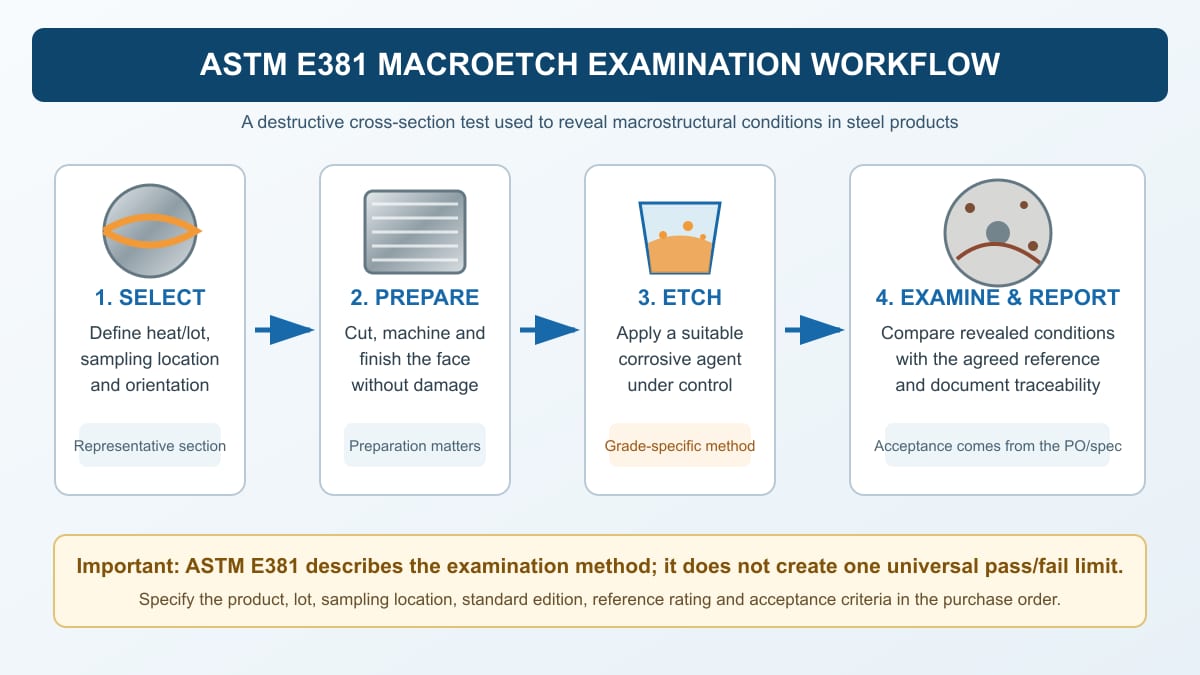
ASTM E381 Macroetch Testing for Stainless Steel Bars: What It Reveals and When to Specify It A stainless steel bar can meet its chemical-composition and tensile-property requirements yet still require examination of its internal macrostructure. Segregation, center porosity, shrinkage-related con...Read more »
-
Market reference date: October 15, 2026. The tables below summarize material-only reference levels converted from publicly visible China-market indications. Cold-rolled prices are based on 1219 mm slit-edge material; hot-rolled prices are based on 1500 mm mill-edge material. Other widths require...Read more »
-
What Is a Wedge Wire Screen Used For? Types and Industrial Applications A wedge wire screen is used to retain, separate, drain or classify solid material while allowing liquid, gas or smaller particles to pass through controlled continuous slots. Common duties include water intake, wastewater sc...Read more »
-
Market reference date: September 28, 2026. The tables below summarize material-only reference levels converted from publicly visible China-market indications. Cold-rolled prices are based on 1219 mm slit-edge material; hot-rolled prices are based on 1500 mm mill-edge material. Other widths requi...Read more »
-
Stainless steel tube ovality tolerance cannot be selected from one universal percentage. The acceptable value depends on whether the item is tube or pipe, its governing standard and edition, outside diameter, wall thickness, manufacturing route, and any tighter drawing requirement. Quick answer:...Read more »
-
For regular square woven steel wire cloth, a practical estimated mass is: G = Mesh × d² ÷ 2. In this empirical formula, G is the mesh mass in kg/m², Mesh is the number of apertures per linear inch, and d is the nominal wire diameter in millimetres. Multiply kg/m² by the ordered area to estimate ...Read more »
-
Market reference date: September 22, 2026. The tables summarize material-only reference levels converted from publicly visible China-market indications. Cold-rolled prices are based on 1219 mm slit-edge material; hot-rolled prices are based on 1500 mm mill-edge material. Other widths require se...Read more »
-
Market reference date: September 20, 2026. The tables summarize material-only reference levels converted from publicly visible China-market indications. Cold-rolled prices are based on 1219 mm slit-edge material; hot-rolled prices are based on 1500 mm mill-edge material. Other widths require sep...Read more »