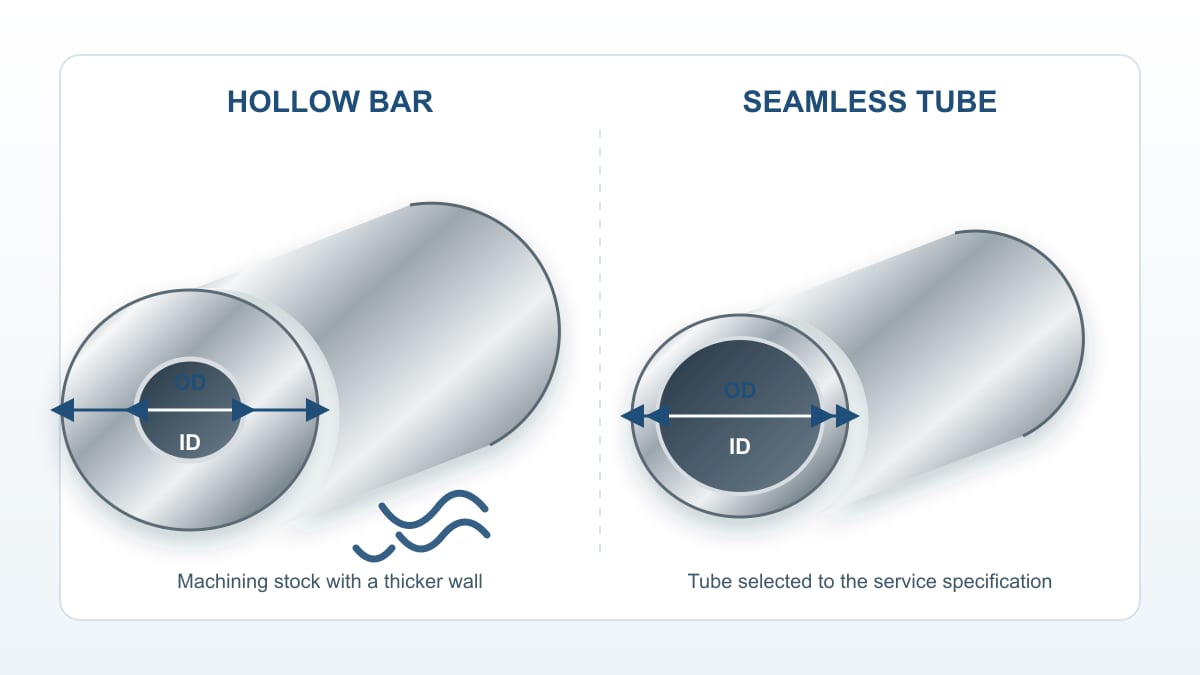
Hollow bar and seamless tube can look similar, but they are not automatically interchangeable. A buyer may receive the right alloy and still create excessive machining, dimensional risk or a specification mismatch if the product form is selected only by outside diameter and wall thickness. The most reliable choice begins with the finished component and the governing service requirement.
Hollow Bar and Seamless Tube Serve Different Buying Purposes
Stainless steel hollow bar is commonly selected as machining stock. Its central bore removes much of the material that would otherwise need to be drilled or bored from solid bar. Seamless tube is commonly purchased as a finished tubular product or as a component blank under a tube specification. Its acceptance may depend on pressure-service requirements, dimensional tolerances, heat treatment, surface condition, nondestructive examination or other tests stated in the order.
| Selection factor | Stainless steel hollow bar | Seamless stainless steel tube |
|---|---|---|
| Typical purchasing objective | Efficient machining of hollow or annular components | Compliance with a specified tubular product or service requirement |
| Dimension focus | OD, ID, machining allowance and clean-up size | OD, wall thickness, length and the tolerances in the applicable tube standard |
| Conversion into a part | Usually turned, bored, threaded or milled | May be used as tube or further processed into a component |
| Cost question | How much stock removal and machining time can be avoided? | What specification, testing and service performance must be satisfied? |
| Main ordering risk | Insufficient machining allowance or unsuitable bore/OD tolerance | Using a tube condition or standard that does not match the design requirement |
Choose Hollow Bar When Machining Efficiency Matters
Less Material Must Be Removed
For a part with a large central bore, hollow bar can reduce the amount of metal removed compared with starting from solid round bar. The practical benefit should be evaluated using the finished OD and ID, the required clean-up allowance and the number of components expected from each length.
OD and ID Allowances Must Clean Up Together
A nominal hollow size is not enough. The purchasing drawing should show the finished dimensions, concentricity or runout requirements where relevant, and the minimum stock allowance needed on both surfaces. If the bore is off-center or the allowance is too small, one surface may not clean up after machining.
Condition Affects the Machining Plan
Grade, heat-treatment condition, straightness, surface condition and hardness can affect cutting behavior and final dimensional stability. These points should be agreed before production, especially for long parts, thin remaining walls or tight final tolerances.
Choose Seamless Tube When the Service Specification Governs
Seamless tube is normally the safer starting point when the drawing or customer specification calls for a recognized tubular product standard, pressure boundary, heat-exchanger duty or defined fluid service. In these cases, the applicable standard may control manufacturing route, dimensions, heat treatment, testing, marking and certification.
- Confirm whether hydrostatic, eddy-current, ultrasonic or other examination is required by the specified standard.
- State whether the finished part remains a pressure-retaining component after machining.
- Check whether the tube wall and tolerances leave enough material for final machining.
- Specify the required inspection certificate and traceability level in the purchase order.
A Five-Step Selection Check
- Start with the finished geometry. Record the final OD, ID, wall thickness, length and critical tolerances.
- Calculate the machining envelope. Add the required allowance for turning, boring, facing and distortion control.
- Identify the governing specification. Separate machining-stock requirements from pressure, structural or fluid-service requirements.
- Compare total conversion cost. Consider yield, cutting time, tool wear, inspection and scrap—not only raw-material price.
- Define acceptance evidence. List the grade, condition, dimensional inspection, testing, marking and certificate requirements.
Information to Include Before Requesting a Quote
A clear inquiry prevents a quotation for the wrong product form and lets the supplier evaluate both material yield and compliance requirements.
| RFQ item | What to state |
|---|---|
| Product form | Hollow bar or seamless tube; identify whether alternatives may be proposed |
| Material | Grade, UNS/EN designation and required product standard |
| Dimensions | OD, ID or wall thickness, length, tolerances and machining allowance |
| Condition | Heat treatment, surface, straightness and any hardness requirement |
| Inspection | Dimensional checks, NDT or pressure testing required by the order |
| Documentation | Material certificate type, traceability, marking and supplementary reports |
| Commercial details | Quantity, cut lengths, destination and required delivery schedule |
Frequently Asked Questions
Is hollow bar the same as seamless tube?
No. They may have a similar hollow cross-section, but their intended use, dimensional basis, applicable standards and acceptance requirements can differ. The purchase order should name the required product form and specification.
Is hollow bar always less expensive?
No. It can lower machining time and material removal for some components, but total cost depends on size, grade, quantity, tolerances, yield, testing and the actual machining route.
Can stainless steel hollow bar be used for pressure service?
Only when the specified material condition, manufacturing route, testing and documentation satisfy the approved design and service requirements. Pressure suitability should never be assumed from the hollow shape alone.
Review our stainless steel hollow bar options, then send the finished dimensions, machining allowance, grade, quantity and inspection requirements for a product-form review.
View Stainless Steel Hollow BarContact SAKY STEEL
Post time: Oct-27-2026