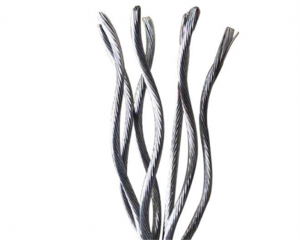
The construction of a stainless steel wire rope determines how its wires and strands share load, bend around hardware and respond to repeated movement. The common constructions 1×19, 7×7 and 7×19 may have the same nominal diameter, but they provide very different combinations of stiffness, flexibility and stretch.
What Does Wire Rope Construction Mean?
Construction notation describes the number of strands and the approximate number of wires in each strand. A 1×19 rope is formed from one strand containing 19 wires. A 7×7 rope is assembled from seven strands, each commonly built with seven wires. A 7×19 rope uses seven strands with 19 wires in each strand. More individual wires generally allow the rope to bend more easily, although detailed behavior also depends on wire diameter, strand geometry and manufacturing tolerances.
Construction is therefore a functional specification, not a cosmetic description. It should appear clearly on the purchase order, drawing and product label.
1×19 Stainless Steel Wire Rope
Performance Profile
1×19 is the stiffest of the three constructions. Its relatively large wires and single-strand arrangement provide low stretch and good dimensional stability in straight runs. It does not tolerate tight bends or repeated flexing as well as more flexible constructions.
Typical Selection Scenarios
- Architectural stays and balustrade infill
- Standing rigging and tension bracing
- Applications where the cable remains substantially straight
Avoid selecting 1×19 for running over small sheaves or frequent articulation. Bending it below the permitted radius can accelerate wire fatigue and distort the construction.
7×7 Stainless Steel Wire Rope
Performance Profile
7×7 offers a middle ground between stiffness and flexibility. It is easier to route than 1×19 but retains more form than 7×19. This balance makes it common in general cable assemblies where moderate bending is expected.
Typical Selection Scenarios
- General-purpose control and support cables
- Guard cables and moderate-flex assemblies
- Applications with occasional movement around larger-radius hardware
It should not be assumed suitable for high-cycle bending without reviewing pulley diameter, load spectrum and fatigue requirements.
7×19 Stainless Steel Wire Rope
Performance Profile
7×19 contains many smaller wires and is the most flexible of these three common constructions. It conforms more readily to pulleys and routing changes, making it a frequent choice for moving cable systems. Greater flexibility does not eliminate fatigue; correct sheave geometry and operating load remain essential.
Typical Selection Scenarios
- Control cables and pulley-operated mechanisms
- Winch, garage-door and exercise-equipment assemblies
- Applications requiring repeated bending or flexible routing
1×19 vs 7×7 vs 7×19 Comparison
| Construction | Relative Flexibility | Typical Behavior | Common Use Direction |
|---|---|---|---|
| 1×19 | Low | Rigid, low stretch | Straight tension members |
| 7×7 | Medium | Balanced handling | General cable assemblies |
| 7×19 | High | Flexible, suited to routing | Moving and pulley systems |
This table is a selection guide rather than a load-rating chart. Breaking force and working-load limits depend on diameter, grade, construction, termination efficiency, safety factor and the governing design code.
Grade, Diameter and Environment Still Matter
Construction alone does not determine suitability. Type 304 is commonly used in general environments, while 316 stainless steel wire rope is often considered for increased chloride resistance. Coated options, including nylon-coated stainless steel wire rope, may be specified where handling, separation or surface protection is needed.
Nominal diameter affects strength and bend capability. A sheave or drum must be sized for the selected rope; forcing a larger or stiffer rope around undersized hardware can shorten service life. Exposure, cleaning access and galvanic contact with other metals should also be reviewed.
Standards and Purchase Specification
ISO 3444:2023 provides requirements for stainless steel wire ropes, including manufacture, classification, testing, packaging, marking and certificates. ASTM A492/A492M covers stainless steel rope wire. The buyer and supplier should identify the applicable standard, revision, acceptance criteria and required documentation before production.
A complete RFQ should state: grade, construction, nominal diameter, length, quantity, lay direction, surface or coating, end fittings, application, relevant standard, test or certificate requirements, packing and destination.
Frequently Asked Questions
Which construction is strongest?
There is no universal answer based on construction notation alone. Compare certified minimum breaking force for the same grade and diameter, then apply the design factor required for the application.
Can 1×19 run over a pulley?
It is generally intended for straight or gently curved tension applications. If pulley operation is required, a more flexible construction and an appropriate sheave diameter should be evaluated.
Should I choose 7×7 or 7×19?
Choose according to required flexibility and bending frequency. 7×7 suits moderate flexibility; 7×19 is usually preferred for repeated bending. Load, hardware and fatigue conditions must also be checked.
Compare purchasing options on the SAKY STEEL stainless steel wire rope landing page, or send your specification for review.
Post time: Aug-11-2026