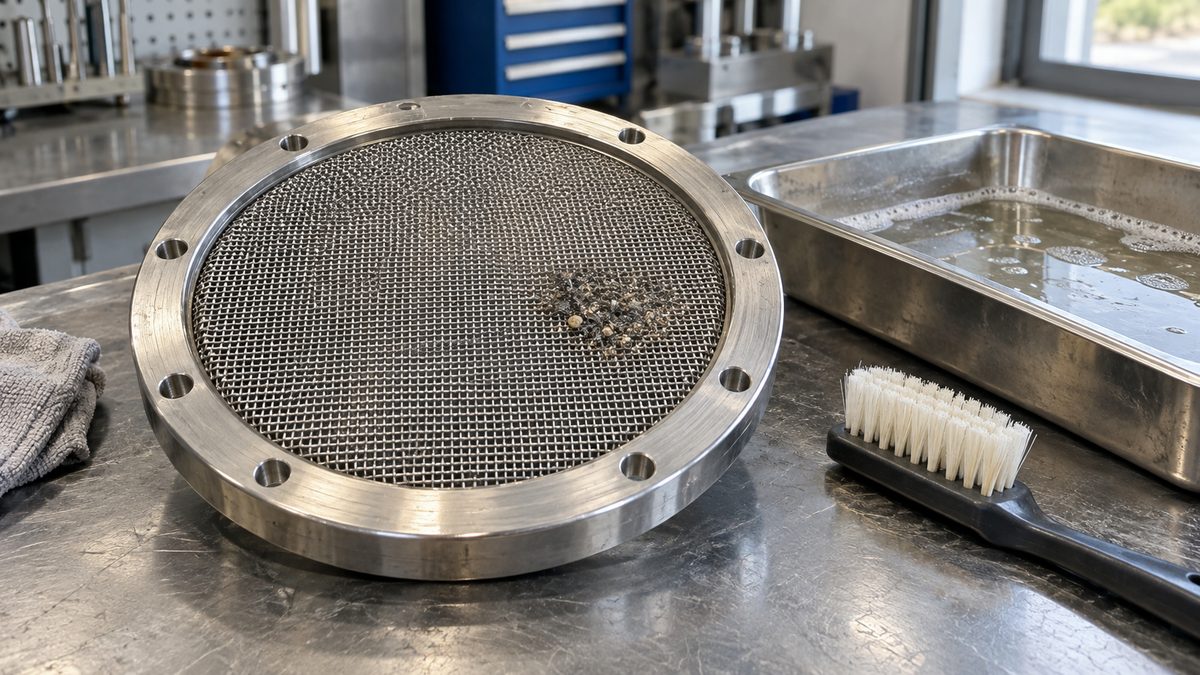
Clean stainless steel wire mesh using a method compatible with the trapped material, wire size and complete filter assembly. A screen that looks clean is not necessarily undamaged or ready for reuse. Identify the deposit first, remove it without forcing particles through the weave, and inspect the openings and attachment points before returning the mesh to service.
This guide is for buyers and maintenance teams specifying reusable woven screens and filter components. Equipment-specific instructions take priority. It does not establish a universal cleaning pressure, chemical concentration or cleaning interval.
Identify Why the Mesh Is Clogging
Trapped particles and surface deposits need different approaches
Particles close to the opening size may lodge between wires. Sticky feed can coat the wire surface, while fine solids may form a cake across the screen. Oil, mineral scale and corrosion products introduce different compatibility questions. Record the process material, deposit appearance and location before selecting a cleaner.
A screen that repeatedly blinds during dry screening may need a change in operating conditions or a suitable deblinding arrangement. Increasing cleaning frequency alone does not resolve a feed that consistently bridges the openings. Deblinding accessories must suit the equipment and mesh construction rather than being improvised.
Check the operating history
For filters, compare flow and differential pressure at comparable temperature, viscosity and operating conditions. A higher pressure loss may reflect loading, but it can also follow a change in fluid or flow. Record the clean-element baseline and the equipment manufacturer’s cleaning or replacement criteria. Do not infer a safe pressure limit from stainless steel grade alone.
Match the Cleaning Method to the Mesh
Gentle rinsing and compatible detergents
For water-compatible residues, a gentle rinse and a suitable detergent may be a practical starting point after the equipment is safely isolated and depressurized. Check compatibility with the stainless grade, frame, welds, seals and any adhesive. Thorough rinsing matters because remaining cleaner can contaminate the next batch or attack another part of the assembly.
Do not select an aggressive acid or chloride-containing cleaner simply because the screen is stainless steel. Chemical choice depends on concentration, temperature, exposure time and the deposit. Use the equipment or chemical supplier’s approved procedure, including handling and disposal requirements.
Fine wire cloth needs protection from mechanical damage
A brush that is acceptable for a robust coarse screen can distort a fine weave. Avoid sharp tools, scraping and forcing lodged particles through the openings. RETSCH’s test-sieve guidance recommends ultrasonic cleaning for fine metal gauze and warns against unsuitable mechanical cleaning. That guidance concerns test sieves, not every industrial filter.
For a fabricated filter, confirm whether its construction permits ultrasonic cleaning, including the attachment method and seals. Start with a qualified procedure rather than copying a laboratory sieve’s cleaning time or bath settings into production.
Backwashing must be an approved design feature
Some filter assemblies are designed for reverse-flow cleaning, while others are not. Confirm the permitted direction, pressure and support arrangement. Repeated pressure reversals can fatigue fine wires or joints. A powerful water jet is not a substitute for a validated backwash procedure.
Inspect the Screen Before Reuse
After cleaning, examine representative areas under suitable lighting and magnification. Look for broken wires, enlarged or distorted openings, creases, corrosion pits, loose edges and damaged frame connections. Inspect the sealing interface separately. A bypass gap can allow oversized particles through even when the wire cloth itself remains intact.
For square-opening cloth, compare the condition against the agreed aperture and wire-diameter requirements. For Dutch weave, visual appearance does not establish filtration performance. Use the agreed integrity or performance check where the application requires one. Dry and store the component in accordance with the approved procedure.
When Should Stainless Steel Mesh Be Replaced?
Replace or obtain engineering review for mesh with broken wires, permanent opening distortion, unacceptable corrosion or unreliable attachment. Also investigate an element that cannot recover the required performance after approved cleaning. Do not keep applying stronger chemicals until it appears brighter.
A repeat failure deserves a root-cause review: incompatible material, excessive pressure cycling, unsupported cloth, abrasive feed, unsuitable cleaning or handling damage. Moving from 304 to 316L may improve suitability in some corrosive environments, but it will not correct an inadequate support structure or cleaning process.
Specify Cleaning Requirements When Buying Replacement Mesh
Include the stainless grade, weave, aperture or verified filtration requirement, wire diameter, overall dimensions and edge construction. State the process fluid or solids, temperature, cleaning chemistry, intended reuse and the filter’s support arrangement. Provide the original drawing where a component must seal into existing equipment.
Review 304 stainless steel wire mesh for suitable general-purpose duties, or 316L stainless steel wire mesh where the service chemistry warrants evaluating a molybdenum-bearing grade. Final selection should consider the complete operating and cleaning environment.
Frequently Asked Questions
Can cleaning restore the original opening size?
Cleaning can remove a deposit. It cannot reliably repair a broken wire or permanently distorted opening. Inspect the cleaned mesh instead of assuming recovered flow proves its integrity.
Is 316L mesh safe with any cleaning chemical?
No. Grade alone does not establish chemical compatibility. Confirm the actual cleaner, operating temperature, concentration and exposure, including compatibility with the complete assembly.
Is a fixed monthly cleaning schedule sufficient?
Not for every process. Use operating history, approved equipment criteria and contamination requirements to set an interval. Review that interval when feed, flow or cleaning conditions change.
Technical references: RETSCH: care of metal-wire test sieves; Wire Cloth Man: filter-mesh durability and aperture.
Need replacement mesh matched to your process? Send the drawing, operating medium and cleaning conditions for a specification review and quotation.
Post time: Sep-18-2026