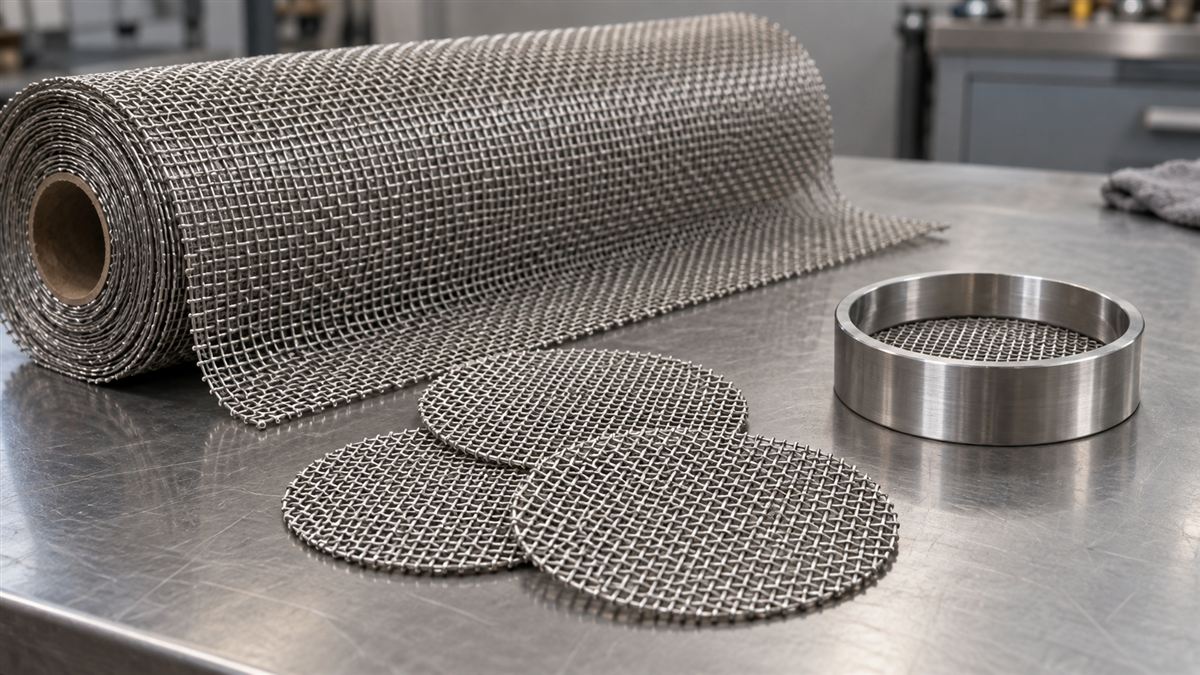
Quick answer: Stainless steel wire mesh does not have one universal pressure-drop value. The result depends on the weave, wire geometry, fluid, flow rate, effective area and whether the mesh is clean or loaded with particles. Compare filtration performance and pressure loss under the same test conditions before choosing a screen or filter.
For a buyer, the important question is not simply “Which mesh has the lowest resistance?” It is “Which construction meets the required separation duty without exceeding the pressure-loss allowance of the complete system?” This guide explains the information needed to make that decision and the limits of a mesh-count specification.
What Does Pressure Drop Across Wire Mesh Mean?
Pressure drop is the difference between the upstream and downstream pressure while fluid flows through the mesh. State its unit and the measurement locations. A result for a finished filter assembly can include losses from its housing, support layers, seals and connections; it should not automatically be attributed to the wire cloth alone.
Clean pressure drop is measured before significant contamination accumulates. Operating pressure drop can increase as retained solids obstruct the flow paths. These are different purchasing and operating questions: an acceptable clean result does not predict how long the filter will run before cleaning or replacement.
Pressure drop is not a strength rating
A flow-resistance result is not the maximum differential pressure that the mesh can withstand. Unsupported span, attachment, backing structure and deformation all matter to mechanical suitability. Obtain a separate assembly-level limit from the responsible designer. Never use an operating pressure-drop curve as proof of burst resistance.
Why Mesh Count Alone Cannot Predict Flow Resistance
Mesh count describes the number of openings per unit length in an applicable construction. Two square meshes with the same count but different wire diameters have different openings and open areas. A count without wire diameter therefore leaves both separation geometry and flow capacity unresolved.
For an ideal regular square weave, pitch in millimetres is 25.4 divided by the count per inch; nominal opening is pitch minus wire diameter. This is a geometric calculation, not a pressure-drop equation or guaranteed particle-retention result. Actual openings and the agreed dimensional tolerances still need verification.
Dutch weave requires a different description
Dutch weave does not behave like an ordinary square screen with one directly visible square opening. Ask for the construction, wire diameters in both directions and the basis used to state filtration performance. A nominal micron description without a defined test method and efficiency is insufficient to establish an equivalent replacement filter.
Compare Results on a Like-for-Like Basis
Ask what fluid was used, its temperature and viscosity, and whether the reported flow is volumetric flow through the sample or flow per unit exposed area. Air and water test results are not interchangeable. A laboratory result also does not establish performance in a viscous process liquid, a gas at another density or a non-Newtonian medium.
Document the exposed area rather than only the outside diameter of a filter disc. Clamping rings and blocked support regions reduce the working area. For pleated or multilayer filters, confirm how the effective area is defined and whether the tested arrangement matches the intended installation.
Request a curve, not an isolated number
A pressure-drop-versus-flow curve with stated conditions is more informative than a single “low resistance” claim. Check whether the required operating point lies within the tested range. Extrapolation beyond that range needs engineering justification; it should not be hidden inside a quotation.
Troubleshoot High Pressure Drop Without Losing Filtration Quality
First distinguish a high clean pressure drop from a rapid increase during service. For a clean assembly, check the installed mesh specification, available area, backing layers and flow direction. For a rising operating value, investigate solids loading, particle distribution, cleaning effectiveness and the possibility of trapped material between layers.
Choosing a larger opening may reduce resistance in some arrangements, but it can also let unacceptable particles pass. Increasing effective filtration area or revising the assembly may be preferable. Any change must preserve the required separation function and be validated for the actual process.
Material grade is a separate decision. Review 304 stainless steel wire mesh for suitable general service and 316L stainless steel wire mesh where the service chemistry warrants evaluation of a molybdenum-bearing grade. Neither grade alone guarantees low pressure loss, chemical compatibility or a particular filtration rating.
What to Include in a Wire Mesh RFQ
Provide the fluid and temperature range; required flow rate; clean pressure-drop allowance; separation target and its test basis; available installation area; weave and wire dimensions if known; material grade; roll or cut-piece dimensions; and whether support layers or a finished assembly are involved. State the cleaning method and any mechanical differential-pressure requirement separately.
If replacing an existing filter, include its drawing and verified operating data rather than only a mesh-count label. Identify which information is measured, which is a design requirement and which remains unknown. This allows a supplier to flag missing information before an apparently equivalent material is ordered.
Frequently Asked Questions
Can I convert mesh count directly into pressure drop?
No. Mesh count is not a hydraulic specification. Wire diameter, construction, fluid properties, area and flow conditions are also needed; use validated test data or an appropriate engineering model.
Does a lower pressure drop mean a better filter?
Not by itself. A filter must meet the required retention performance, operating stability and mechanical limits. Lower resistance achieved by allowing unwanted particles through is not an improvement.
Can 316L mesh replace 304 without changing performance?
Do not assume equivalence from the grade name. Match the weave, wire dimensions, filtration basis and installed configuration, then separately confirm compatibility with the service environment.
For a specification review, send your process conditions, mesh construction and required acceptance basis. Any performance commitment should be agreed for the actual material or assembly, not inferred from this general guide.
Post time: Sep-17-2026