-
Magnets play a vital role in modern technology — from electric vehicles and wind turbines to smartphones, medical equipment, and aerospace systems. But not all magnets are created equal. Some materials can generate extremely powerful magnetic fields, while others are only weakly magnetic or even ...Read more »
-
When we think of metals, most people immediately associate them with magnetism. After all, materials like iron, cobalt, and nickel are well-known for their strong magnetic properties. However, not all metals are magnetic — in fact, several widely used metals do not react to magnets at all. These ...Read more »
-
.saky-news-content{font-family:Poppins,Arial,Helvetica,sans-serif;font-size:14px;line-height:1.8;color:#333;} .saky-news-content h2{background:#1769aa!important;color:#fff!important;padding:12px 18px!important;margin:30px 0 18px!important;font-family:Arial,Helvetica,sans-serif!important;font-si...Read more »
-
Many people are surprised to learn that not all types of steel are magnetic. In fact, some steels do not stick to magnets at all. This property is particularly valuable in industries such as marine engineering, food processing, medical equipment, and electronics, where magnetic interference or co...Read more »
-
When choosing stainless steel for applications that require both corrosion resistance and non-magnetic behavior, engineers and designers often face the question: What is the best non-magnetic stainless steel? Not all stainless steels are created equal — while most are resistant to rust and corros...Read more »
-
When people think of steel, they often imagine a strong and magnetic metal. However, not all steels are magnetic. In fact, certain types of steel—especially specific grades of stainless steel—are known for being nonmagnetic or only slightly magnetic. Understanding what makes some steels nonmagnet...Read more »
-
Stainless steel is one of the most versatile and widely used materials in modern engineering, architecture, energy, and manufacturing. Known for its durability, corrosion resistance, and aesthetic appeal, stainless steel comes in many grades and families. While there are over 150 different stainl...Read more »
-
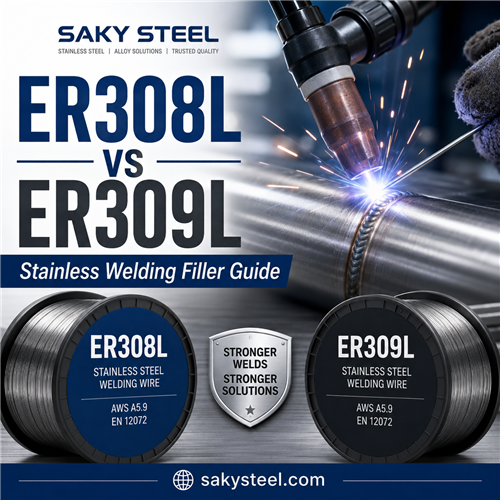
308 vs 309 Filler: The Base-Metal Combination Decides For common austenitic stainless-to-stainless joints, a 308-type filler is often the starting family; 309-type fillr is commonly considered for stainless-to-carbon-steel or dissimilar joints because of its higher alloy content. This is not a ...Read more »
-
Grade selection must separate high-temperature oxidation from aqueous corrosion, then confirm product form, condition and governing standard. Selection answer: 309-family stainless steels are generally evaluated when elevated-temperature oxidation resistance and high-temperature service are th...Read more »
-
A Detailed Comparison by SAKYSTEEL Stainless steels are essential in modern industries, from chemical plants and shipbuilding to oil and gas systems. Among the many available grades, SS 316 and SS 329 are two commonly used materials that often cause confusion among buyers and engineers. Both are ...Read more »
-
Exploring Properties, Applications, and Advantages from SAKYSTEEL In today’s industrial world, stainless steels play a vital role in manufacturing, energy, marine, and chemical sectors. Among the many grades, 329 stainless steel has gained increasing attention for its exceptional balance of stren...Read more »
-
The global steel and alloy industry relies heavily on advanced melting technologies to ensure product quality, consistency, and efficiency. In today’s competitive manufacturing environment, furnaces such as the medium frequency melting furnace, the vacuum melting furnace, and the electric arc fur...Read more »
-
Heat exchangers are critical components in many industries, from power plants and petrochemical facilities to food processing and pharmaceutical production. Among various designs, U-tube heat exchangers are widely used because of their ability to handle thermal expansion, compact design, and effi...Read more »
-
Heat exchangers play an essential role in industries such as chemical processing, oil and gas, power generation, food and beverage, pharmaceuticals, and marine engineering. Among the critical components of heat exchangers, the tube material determines not only the efficiency of heat transfer but ...Read more »
-
Steel plates are the foundation of countless industries, from construction and shipbuilding to oil and gas, heavy machinery, and aerospace. Each steel plate is manufactured to specific grades, ensuring that it meets required standards of strength, toughness, corrosion resistance, and weldability....Read more »